
Quantum-Secure Computing and Next-Generation Cybersecurity Architectures Dissertation Topics I phdassistance.com
Info: Quantum-Secure Computing and Next-Generation Cybersecurity Architectures Dissertation Topics I phdassistance.com
Published: 06th July in Quantum-Secure Computing and Next-Generation Cybersecurity Architectures Dissertation Topics I phdassistance.com
Share this:
Related Services
Our academic writing and marking services can help you
Introduction
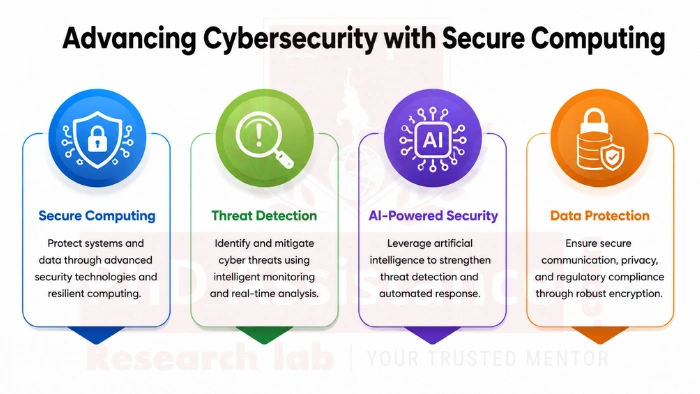
The field of quantum computing is revolutionising contemporary cybersecurity through the emergence of new computing powers alongside new security risks associated with digital infrastructures. The recent breakthroughs in post-quantum cryptographic schemes, Artificial Intelligence, and intelligent security architecture are enabling researchers to come up with secure computing platforms that can mitigate future cyberattacks. Quantum-Secure Computing Research is central in designing effective cybersecurity platforms that not only protect sensitive data but also provide secure means of communication. Nevertheless, there are several major challenges in terms of the scalability of Quantum Security techniques, their compatibility with current infrastructure, and the development of responsive cybersecurity strategies for quantum cyberattacks. The current body of literature emphasises the importance of creating an integrated framework for intelligent security techniques along with quantum-computing strategies.
Proposed PhD Topic 1: AI-Driven Quantum Cybersecurity Architectures for Strengthening Next-Generation Cybersecurity in Intelligent IoT Systems
Background Context:
The exponential growth in Internet of Things (IoT) technologies has greatly affected digital connectivity in the health care, manufacturing, transport, and smart cities domains. On the downside, the interconnectivity of the technologies has created more vulnerabilities for IoT systems through advanced attacks in cyberspace, especially through the use of quantum computing. As noted by Saeed and Alqahtani (2025), there are promising results that come out of using Artificial Intelligence with Quantum Security to solve problems in cybersecurity in IoT networks. For example, the application of technologies like anomaly detection, prediction, and automation makes it easy for cyber defence to operate in a safe manner, as quantum-based encryption algorithms increase security in the long run. Despite all these developments, the integration of AI and Quantum & Next-Generation Cybersecurity Frameworks are still insufficient.
PhD-Level Verification:
While existing literature provides independent insights into AI-based cyber threat detection, IoT security, and Quantum Security, there is still a lack of investigations of their integration in one unified framework aimed at the provision of intelligence threat prediction, adaptation to changes, and quantum resistance. Empirical verification of such concepts on heterogeneous IoT platforms is also rather rare, providing an obvious gap in the field.
Research Questions:
PhD-Level Contributions:
Suggested Readings:
Saeed, M. M., & Alqahtani, F. (2025). AI and Post-Quantum Cryptography Powered Cybersecurity Approaches for IoT Systems: A Literature Review.
Proposed PhD Topic 2: Strategic Quantum Cybersecurity Architectures for Strengthening Quantum Security in Critical Infrastructure Systems
Background Context:
The quantum computing evolution poses an imminent threat to national security across healthcare, financial, government, and energy infrastructure by jeopardising current cryptographic systems, highlighting the imperative for Quantum Security. The National Academy of Sciences’ “Quantum Technology” committee asserts that governments and industries must accelerate their adoption of Quantum Cybersecurity strategies in addition to fostering resilient defences to the future threat environment by utilising intelligent Next Generation Cybersecurity Architectures for a sustainable national security architecture [1; Troublefield, 2026]. But there are several obstacles to this transition that include issues like moving current infrastructure into post-quantum systems, regulatory concerns, and preparation. A Quantum Security Framework with efficient ways of governing and managing risk, as well as being adaptable, can safeguard national infrastructure from future computational threats.
PhD-Level Verification:
Prior research has mainly focused on quantum threats, migration approaches, and organisational readiness as individual areas of study. Yet, very few researchers have combined the study of governance policies, risk assessment, Quantum Security, and Cybersecurity to develop an all-encompassing Cybersecurity Architecture for critical infrastructure protection. In addition, there is still a lack of research models that facilitate quantum-safe transition across enterprises.
Research Questions:
PhD-Level Contributions:
Suggested Readings:
Zhang, L., Wang, Z., Yang, R., & Yi, Q. (2025). Digital Presentation and Interactive Learning for Intangible Cultural Heritage Preservation Using Artificial Intelligence.
Proposed Dissertation topic 3: Hybrid Quantum Security and Cybersecurity Architectures for Resilient Distributed Digital Infrastructures
Background Context:
As advancements keep on happening in the field of quantum computing, enterprises are realising the shortcomings of traditional cryptography methods for safeguarding their distributed digital infrastructure. Hybrid security techniques combining classical cryptography along with Quantum Security techniques have been proposed as possible solutions in ensuring continued business operation in quantum-resistant systems. As per Vareta et al. (2025), hybrid cryptography schemes offer more flexibility by providing compatibility with traditional systems along with resistance to any quantum-based attacks in the future. But despite this, there remain issues of interoperability, complexity of implementation, performance tuning, and massive-scale deployment. Implementing intelligent Cybersecurity methods using a Next-Generation Cybersecurity Architecture can help achieve this.
PhD Level Verification:
Current research mostly focuses on hybrid cryptography systems from the technical point of view without paying much attention to the implementation in business environments and the long-term performance of such systems. There is currently a lack of a framework in terms of Cybersecurity that considers hybrid Quantum Security, the transition process, and Cybersecurity solutions.
Research Questions:
PhD-Level Contributions:
Suggested Readings:
Buragohain, D., Buragohain, D., Meng, Y., Deng, C., & Chaudhary, S. (2025). A Metaverse-Based Digital Preservation of Temple Architecture and Heritage.
Proposed Dissertation Topic 4: AI-Enabled Quantum Cybersecurity Architectures for Intelligent Quantum Security and Adaptive Cyber Defence
Background Context:
The emergence of Artificial Intelligence has played a critical role in fortifying the cybersecurity space through intelligent threat detection and predictive analysis. At the same time, there is an emergence of new security challenges due to the advent of quantum computing that raises serious concerns about the efficacy of cryptography. As per Yedalla (2026), the integration of intelligent cybersecurity measures based on Artificial Intelligence and Quantum Security can lead to the creation of intelligent cybersecurity systems that could effectively deal with emerging security threats. While artificial intelligence has increased the accuracy of cyber threat detection, traditional security systems do not have any AI-based decision-making in their Cybersecurity solutions.
PhD-Level Verification:
Most of the literature focuses on Artificial Intelligence, cybersecurity, and Quantum Security individually. Few research papers discuss Intelligent Cybersecurity Architectures that merge AI-based threat prediction and automation along with cybersecurity into one framework. Additionally, there is very little practical analysis performed regarding adaptive AI-based post-quantum cyber defence, hence providing excellent prospects for research at the doctoral level.
Research Questions:
Contributions at the PhD-Level:
Suggested Readings:
Yedalla, J. (2026). Quantum Computing and AI: The Future of Cybersecurity Defense Mechanisms.
Proposed Dissertation Topic 5: Integrated Quantum Cybersecurity and Quantum Security Frameworks for Protecting Future Digital Infrastructure
Background Context:
The continuously evolving complex cyber threats alongside the swift progress of Quantum Computing technologies are reshaping our global cybersecurity world. The traditional security approaches are proving inadequate to protect sophisticated digital infrastructure from quantum-powered cyberattacks in future. Hossain (2025) suggested that AI, quantum computing, and Quantum Security are complementary technologies that could be applied for smart and robust cybersecurity solutions. Though traditional cybersecurity solutions have facilitated better detection of attacks and response to incidents, these are not adequate enough to counter quantum threats effectively. Hence, the implementation of integrated Cybersecurity in the framework of Next-Generation Cybersecurity systems is required to enable a safer digital transformation, promote cyber resilience and safeguard crucial data across a connected digital universe.
PhD-Level Verification:
Literature has mostly focused on studying Artificial Intelligence, quantum computing, and cybersecurity separately. Very few papers have put forward the idea of developing a Cybersecurity Architecture that will incorporate intelligent automation, Cybersecurity, Quantum Security, and risk management. In addition to this, very little has been done towards the validation of the security frameworks across multiple industries.
Research Questions:
PhD-Level Contributions:
Suggested Readings:
Hossain, K. (2025). Harnessing Quantum Computing and Artificial Intelligence for Next-Generation Cybersecurity: A Comprehensive Review.
Need assistance finalising your dissertation topic? Selecting a strong, researchable topic can be challenging — but you don’t have to do it alone.
Our research consultants can help refine your ideas, identify literature gaps, and guide you toward a topic that aligns with current academic trends and your programme requirements.
Contact us to begin one-on-one topic development and refinement with PhdAssistance.com Research Lab.
Share this:
Cite this work
PhDAssistance. (n.d.). Cybersecurity in business Dissertation Topics Retrieved January 28th, from https://phdassistance.com/topic/cybersecurity-business/
Jalolova, M., and Musawwir, M. “Cybersecurity in business Dissertation Topics for PhD Scholars.” PhDAssistance, https://phdassistance.com/topic/cybersecurity-business/ Accessed 28th January 2026.
Jalolova, M., and Musawwir, M., n.d. Cybersecurity in business Dissertation Topics for PhD scholars. [online] Available at: https://phdassistance.com/topic/cybersecurity-business/ [Accessed 28th January 2026].
Jalolova M., Musawwir M. Cybersecurity in business Dissertation Topics for PhD scholars [Internet]. PhDAssistance; [cited 2026 28th January]. Available from: https://phdassistance.com/topic/cybersecurity-business/
Jalolova, M., and Musawwir, M. (n.d.). Cybersecurity in business Dissertation Topics for PhD scholars. Retrieved 28th January 2026, from https://phdassistance.com/topic/cybersecurity-business/
Jalolova, M., and Musawwir, M., Cybersecurity in business Dissertation Topics (n.d.) https://phdassistance.com/topic/cybersecurity-business/ accessed 28th January 2026.
Study Resources
Free resources to assist you with your university studies!