Mentoring for revise-and-resubmit, reviewer responses and rejected manuscripts

Responding to Reviewer and Editor Comments

Mentoring to understand a journal decision, revise your manuscript and write a clear, point-by-point response to the editor and reviewers.

Received a major revision, a minor revision or a reject-and-resubmit decision? Your mentor, a published researcher in your field, works with you to interpret each comment, plan the changes, revise your own manuscript and draft a respectful, evidence-based response letter that you submit under your name.

Why it matters

Why your response to reviewers matters

A revision or rejection decision is a normal part of publishing, and a revise-and-resubmit decision is an invitation to continue. Even strong research can stall at this stage because of vague responses, changes that do not match what the letter claims, missed formatting requirements or unclear academic English.

Responding well is more than replying. You need to understand what each reviewer is really asking; plan and make the revisions; meet the journal's editorial and formatting requirements; and explain every change clearly, in a cover letter to the editor and a point-by-point response to the reviewers. For researchers with teaching, clinical or project duties and a fixed resubmission deadline, this takes time they rarely have.

Your mentor is a researcher in your discipline who has published in peer-reviewed journals, supported by language editors. They work with you on your own manuscript and your own data, so the science, the decisions and the final response remain yours.

  1. 01

    Understand the decision

    Know what the editor expects next, whether a revision, a new submission or a different journal.

  2. 02

    Address every comment

    Each point is answered, with the change and its location in the manuscript, so nothing is missed.

  3. 03

    Respectful disagreement

    Where a reviewer is mistaken, you explain why, politely and with evidence.

  4. 04

    Consistent documents

    The tracked manuscript, clean copy and response letter say the same thing.

  5. 05

    Journal compliance

    Word counts, reference style, figure files and declarations meet the journal's requirements.

  6. 06

    Ethical revision

    All changes rest on your own data and analyses, with transparent reporting.

Our approach

How a strong revision is built

Your mentor works through the decision letter and every comment with you before any text is changed. These are the principles we follow.

01

Read the decision correctly

Journals use different wording, but most decisions fall into a few types. Minor revision: small changes, usually checked by the editor. Major revision: substantial changes, usually sent back to the reviewers. Reject and resubmit (sometimes called a soft rejection): the paper is not accepted in its current form, but a substantially revised version may be submitted as a new manuscript, often to new reviewers. Reject (a hard rejection, including a desk rejection by the editor before review): the journal will not consider the paper again, so you revise and submit elsewhere. Some publishers offer to transfer a rejected paper, with its reviews, to another of their journals.

02

Map and triage every comment

We number each comment (for example R1.3 for Reviewer 1, comment 3), group related points, separate essential changes from suggestions and flag any comments where reviewers disagree with each other. Where reviewers conflict, the editor's letter usually shows which view to follow; if not, you explain your choice.

03

The point-by-point response letter

The letter thanks the editor and reviewers, then reproduces every comment in full, followed by your response: what you changed, why, and where (section, page and line numbers), quoting the revised text where it helps. Comments you did not act on are answered too, with your reasons. The tone is courteous and factual, never defensive.

04

Tracked changes and a clean copy

Most journals ask for a marked version showing every change (tracked changes or highlighted text) and a clean version for production. Page and line numbers in the response letter must match the version the journal asks you to cite.

05

Disagreeing respectfully, with evidence

You do not have to accept every suggestion. When a reviewer has misread the study or asks for something inappropriate, the response acknowledges the point, explains your position and supports it with references, your data or an added clarification in the text. The editor makes the final decision, so the aim is to persuade the editor, not to win an argument with the reviewer.

06

Additional analyses, only with your data

Reviewers often ask for extra analyses, sensitivity checks or clearer reporting of assumptions and model fit. Your mentor helps you plan and interpret these, and you run them, or we run them with you, on your own data. We never create, alter or estimate data. If a request needs data you do not have, the response explains this honestly and, where appropriate, adds it as a limitation.

07

Citations suggested by reviewers

Add suggested references when they are relevant and strengthen the paper. If a reviewer asks you to cite a set of unrelated papers, possibly their own, you may decline politely and, if needed, raise it confidentially with the editor, as COPE guidance on citation manipulation advises.

08

Deadlines

The decision letter sets the resubmission deadline, which varies by journal and decision type. If you need more time, ask the editor for an extension before the deadline passes; a late revision may be treated as a new submission.

09

Appeals

Most journals have an appeals process, but appeals succeed only when a decision rests on a clear factual error, a misunderstanding of the work or a possible conflict of interest, not simply on disagreement. An appeal is a short, factual letter to the editor. While it is under consideration, you should not submit the paper to another journal. Often, revising for a different journal is the faster route.

10

After a rejection

Before submitting elsewhere, address the reviewers' comments anyway: the next journal may send the paper to the same reviewers. Then reformat the manuscript to the new journal's guidelines and write a fresh cover letter.

What we cover

Support across the whole revision

Every revision is different. These are the areas your mentor can help with, alone or together.

  • 01

    Interpreting reviewer comments

    Separating major from minor points and identifying what each reviewer actually needs to see.

  • 02

    Response letter drafting

    Planning concise, respectful, point-by-point responses, each checked against the matching change in the manuscript.

  • 03

    Content and structural revision

    Revising the argument, methods, results and discussion as the comments require, keeping the manuscript coherent and consistent.

  • 04

    Statistical clarification

    Explaining test and model choices, reporting assumption checks, effect sizes and confidence intervals, and presenting results in the journal's style.

  • 05

    References and citations

    Adding relevant new references, updating citations in the journal's style (such as APA, Vancouver or Harvard) and cross-checking them with EndNote, Zotero or Mendeley.

  • 06

    Figures and tables

    Improving clarity, labels, legends and captions, adding or removing items as reviewers request, and checking cross-references.

  • 07

    Similarity concerns

    Where a reviewer or editor flags overlapping text, rewording with you, adding missing citations and explaining the changes in the response.

  • 08

    Ethics, disclosures and statements

    Revising conflict of interest, ethics approval, funding and data availability statements as the journal requests, in both the manuscript and the cover letter.

  • 09

    Language editing

    Improving clarity, academic voice and flow, and addressing any language or style issues the editor raised.

  • 10

    Journal formatting after review

    Applying word limits, structured abstracts, reference style and figure and file requirements, including a new journal's guidelines after rejection.

  • 11

    Resubmission cover letter

    A letter to the editor summarising the main changes and, for a new journal, the paper's contribution and fit.

  • 12

    Compliance checklist

    A final check that every reviewer and editor instruction has been answered and that anonymity, supplementary data and disclosure requirements are met.

Sample work

Sample work

Examples of research papers from our sample library, showing the style and structure of our work.

What you get

What's included in reviewer response support

Here is what we need from you, what you receive, and what sits outside this service.

What we need from you

Send these with your request.

  • The decision letter and all editor and reviewer comments
  • The manuscript as submitted, with figures, tables and supplementary files
  • The target journal's name and author guidelines
  • Your data and analysis outputs, if reviewers asked for new or changed analyses
  • The resubmission deadline
  • Your own view of which comments you agree or disagree with

What's included

Part of every reviewer response order.

  • An assessment of the decision and a numbered summary of all comments
  • A revision plan agreed with you before changes are made
  • Revision of your manuscript in tracked and clean versions
  • A point-by-point response letter, formatted to the journal's requirements
  • A resubmission cover letter
  • Formatted figures, tables and supplementary files
  • Updated references and a reference library file (Zotero or EndNote)
  • A similarity report on request
  • Guidance on using the submission system, such as ScholarOne or Editorial Manager

Not included

Available as add-ons or other services.

Also included with your order

Every reviewer response order comes with added support: referencing, sources and guidance from a mentor in your research area.

Referencing

Citations follow the journal's style, such as APA 7th edition, MLA 9th edition, Vancouver, Harvard or Chicago, managed in EndNote, Zotero or Mendeley.

Peer-reviewed sources

New references come from databases such as Scopus, Web of Science, PubMed, IEEE Xplore, JSTOR and ProQuest, and are checked to be traceable and relevant.

Subject experts

Your mentor works in your area, from engineering, computer science and the life sciences to clinical medicine and epidemiology, social sciences and public policy, management, finance, law and the humanities.

Publisher requirements

We are familiar with the submission requirements of major publishers such as Elsevier, Springer Nature, IEEE, Wiley, SAGE and Taylor & Francis, and always follow the target journal's own guidelines.

Responsible use of AI

Revisions are made by people. Many journals now require authors to disclose any use of AI tools in preparing a manuscript; your mentor can explain your target journal's policy.

Find your starting point

Where are you with your revision?

Research journeys are rarely straightforward, with hurdles, surprises, hard work, beginnings and endings. PhD Research Lab travels this journey with you, mentoring researchers worldwide.

“I have detailed comments from the reviewers about how I wrote my results section, but I'm confused about how to rewrite it to explain the statistics clearly.”
CharlottePhD scholar
How we help Interpreting comments and revising results

We help you understand what the reviewers expect, especially in statistical reporting, and turn their comments into clear changes: reporting exact p-values, effect sizes and confidence intervals in the format your journal uses.

Usually works best: Fixed price Talk to us
“The reviewers asked me to clarify how I chose the statistical tests in my analysis, and I need to justify those decisions.”
EmilyPhD scholar
How we help Clarifying test selection

We help you explain why each test suits your variables, design and research aims, and revise both the methods section and your response letter so the reasoning is clear.

Usually works best: Hourly mentoring Talk to us
“The reviewers questioned my use of logistic regression. I need to explain why it was appropriate for my model.”
JamesResearcher
How we help Justifying your analytical choices

We help you write an accurate, referenced response that explains your choice, for example logistic rather than linear regression for a binary outcome, and how you assessed model fit, in the context of your research question.

Usually works best: Hourly mentoring Talk to us
“One reviewer asked how I checked the assumptions and robustness of my statistical models.”
ThomasResearcher
How we help Assumption checks and robustness reporting

We help you document how you checked assumptions such as normality of residuals, multicollinearity and model fit, report any robustness or sensitivity analyses you ran on your data, and present them in the manuscript and response.

Usually works best: Fixed price Talk to us

Scenarios are illustrative, based on requests we often receive from researchers.

Packages & pricing

Choose the support that fits your stage

We offer reviewer response support at three levels, depending on the decision you received and the work it needs. Prices depend on your discipline, the number and depth of comments, and your deadline; every package starts with a free assessment of your decision letter and comments.

Prices for

Prices in USD, PhD level shown. Master's is 15% lower; postdoc and faculty 15% higher. Your exact price is confirmed in a free quote.

Basic

For minor revisions and focused reviewer comments.

From$149
Delivered in 3 to 5 working daysChoose Basic
  • Point-by-point response letter
  • Resubmission cover letter
  • Light language editing
  • Journal formatting of references and figures
  • Section-by-section restructuring
  • Consultation call with a subject expert
Recommended

Standard

For major revisions and reject-and-resubmit decisions.

From$299
Delivered in 5 to 7 working daysChoose Standard
  • Journal targeting suggestions

Premium

For rejected manuscripts heading to a new journal, and complex revisions.

From$499
Delivered in 7 to 10 working daysChoose Premium
  • Everything in Standard
  • Comprehensive language editing
  • Reformatting for a new journal after rejection
  • Suggestions for suitable target journals
  • A 60-minute call with a subject expert
  • Full resubmission package: tracked and clean manuscripts, response matrix and files

Add-ons

Add any of these to a package, now or later. Your mentor stays the same.

See full pricing →
Our process

How it works, from decision letter to resubmission

One single point of contact (SPOC) stays with you through every step, so you always know who to ask.

  1. 1Before we startSubmit your requirementsFill in the secure order form, upload the decision letter, the comments and your manuscript, and pay online so we can start right away.
  2. 2Day 1Confirmation and mentor matchYou receive an order confirmation, and we assign a mentor with experience in your subject and research method.
  3. 3ThroughoutRegular updatesWe keep you informed of progress, and you can share new instructions from the editor, your co-authors or your supervisor at any point.
  4. 4While we workRevision, editing and checksYour mentor works through the agreed revision plan with you. A language editor then reviews grammar, structure and academic style, and a similarity check is run before delivery.
  5. 5ReviewReview and revisionsYou and your co-authors review the drafts, and we revise them within the agreed scope.
  6. 6DeliveryFinal delivery and feedbackYou receive the revised manuscript, response letter, cover letter and files by email and through your client portal, ready for you to submit. We welcome your feedback.
Our guarantee

What we promise, we deliver

PhD Research Lab frames every reviewer response to your target journal's author guidelines, its editor's instructions and recognised publication ethics, such as the COPE guidelines. Our mentors have supported researchers at universities around the world, including the UK, the Netherlands, the USA, Australia, the UAE, India, Kenya, Nigeria, China and Russia, and they know the review processes of major publishers.

Scholars we have supported study in
  • UK
  • USA
  • Netherlands
  • Germany
  • Ireland
  • Australia
  • UAE
  • Saudi Arabia
  • Qatar
  • Kenya
  • Nigeria
  • Russia
  • and more
  • Original workEvery document is checked for plagiarism before delivery.
  • On-time deliveryDelivered by the date we agree when you order.
  • Subject matter expertiseA mentor with doctoral-level knowledge of your field.
  • Talk to your mentorMessage your mentor directly through your single point of contact.
  • Ongoing supportQuestions answered at every step, before and after delivery.
  • Current academic sourcesBuilt on recent, peer-reviewed literature.
  • Research articles supplied*Copies of key articles used for your topics.
  • ConfidentialityYour details and work are never shared.

*Where access and copyright allow.

Quality and compliance

See how we keep every project on track

We have supported PhD projects for scholars around the world, and every task follows the same checks. These are real screens from our workflow.

Project brief checklist showing scope, university guidelines and deadline
Step 1 · Project brief Requirements confirmed in writing You share your requirements, university guidelines and deadline, and your point of contact confirms the scope with you before work starts.
Subject-matched mentor allocation for your project
Step 2 · Mentor allocation A subject-matched mentor is assigned Your project is assigned to a mentor who knows your subject and method, and you are introduced before the work begins.
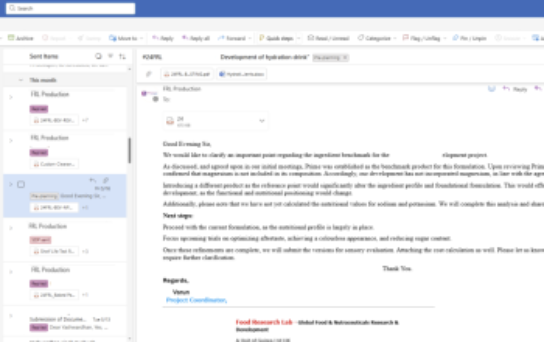
Email thread between a scholar and our project coordinator
Step 3 · Regular updates Communication through email Updates, questions and changes from your supervisor go through your single point of contact, so you always have a written record.
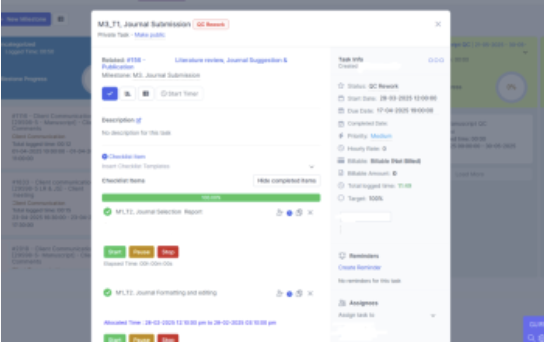
Task record in our ERP system showing checklist items and quality-check status
Step 4 · Quality check Quality check in our ERP system Every task is tracked in our project system, with checklists and a manager's quality check before the work moves on.
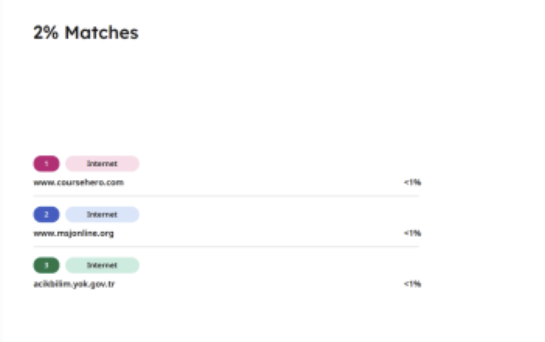
Plagiarism report showing a 2% overall match
Step 5 · Plagiarism check Plagiarism report Each document goes through a similarity check before delivery, so you can submit it with confidence.
FAQs

Frequently asked questions

Ask a mentor
What does reviewer response support include?

Mapping all reviewer comments; drafting clear, point-by-point responses; revising your manuscript to address the comments; clarifying statistical methods and results where reviewers ask; formatting tables, figures and references to the journal's requirements; language editing; and a final check and cover letter for resubmission.

What does my mentor check when revising my manuscript?

That every comment has been answered; that statements are supported by evidence; that conclusions follow from the data; that ethical issues and declarations are addressed; that jargon and abbreviations are kept to a minimum; and that the manuscript is consistent and matches the journal's style and format. We read your paper from your perspective, and are kind but honest about what needs to change.

Do I have to make every change a reviewer asks for?

No. You should respond to every comment, but you may decline a suggestion if you explain why, politely and with evidence. The editor decides whether your explanation is acceptable.

A reviewer asked for an analysis I cannot run with my data. What should I do?

Explain in your response why the analysis is not possible with the data you have, offer an alternative if one exists, and add the point as a limitation where appropriate. We never create or estimate data to satisfy a request.

Should I appeal a rejection?

Only if the decision rests on a clear factual error or misunderstanding. Disagreement alone rarely succeeds. In most cases, revising the paper using the comments and submitting it to another suitable journal is quicker.

Will my paper be accepted after revision?

No one can promise acceptance: the decision belongs to the editor. What we can do is help you answer every comment fully, clearly and honestly, which gives your revision the best chance of a fair reading.

Can I talk to my mentor?

Yes. You can contact your mentor by email, chat or call, and our project coordinators can arrange a direct appointment.

Do you charge extra for revisions?

Revisions within the agreed scope of your package are included, so the documents reflect your co-authors' and supervisor's feedback. Please read our terms and conditions when you place an order.

How is pricing set?

Prices depend on the number and depth of comments, your discipline and your deadline. Our project coordinators can tell you about current seasonal discounts and referral offers.

Can I learn to do this myself?

Yes. Your mentor explains each decision as you go, and the PhD Research Lab Academy offers a course in journal manuscript writing. See the Academy.