
Who this list is for
This list is for doctoral researchers in health informatics, clinical NLP and computer science who want to work on automated clinical coding. Coding turns diagnoses and procedures recorded in free-text notes into ICD codes used for reimbursement, statistics and research. Venkatesh et al. (2023) describe why automation is hard: clinical documents are long and redundant, code sets change, and training data are incomplete. They also argue for involving coders in development, transparent models and systems tailored to a specific use.
How to use this list
Treat each row as a starting point. Decide first which data you can use: a public de-identified database, or notes from a partner hospital under an approved protocol. Then check what has been published since the sources below. If you are still choosing a broad area, start with how to choose a PhD topic and how to select a PhD topic.
Theme 1: Long notes, rare codes and scarce labels
A systematic review of automated ICD coding from discharge summaries identified data scarcity, label imbalance and poor performance on rare codes as persistent problems (Kaur et al., 2021). Transformer models (Vaswani et al., 2017) handle language well but have limits on input length, which matters because discharge summaries are long.
| Topic | Possible research question | Likely design and data | Why it matters now |
|---|---|---|---|
| Transformer models for long and complex clinical notes | Which strategies for long inputs (chunking, hierarchical encoders, long-context models) give the best coding accuracy on discharge summaries, at what computational cost? | Benchmark comparison on a de-identified discharge-summary data set; micro and macro metrics; runtime | Clinical documents are long and redundant (Venkatesh et al., 2023) |
| Learning rare ICD-10 codes from few examples | Do code-description embeddings or few-shot methods improve recall for rare codes without reducing performance on common codes? | Stratified evaluation by code frequency; macro-averaged and per-band metrics; error analysis | Rare-code performance is a known weakness (Kaur et al., 2021) |
| Active learning to reduce expert annotation | Can active learning reach a target accuracy with substantially fewer coder-labelled notes, especially for infrequent codes? | Simulation on a labelled data set (labels revealed on request), then a small study with real coders | Expert labels are expensive and scarce (Kaur et al., 2021) |
Theme 2: Context and code hierarchy
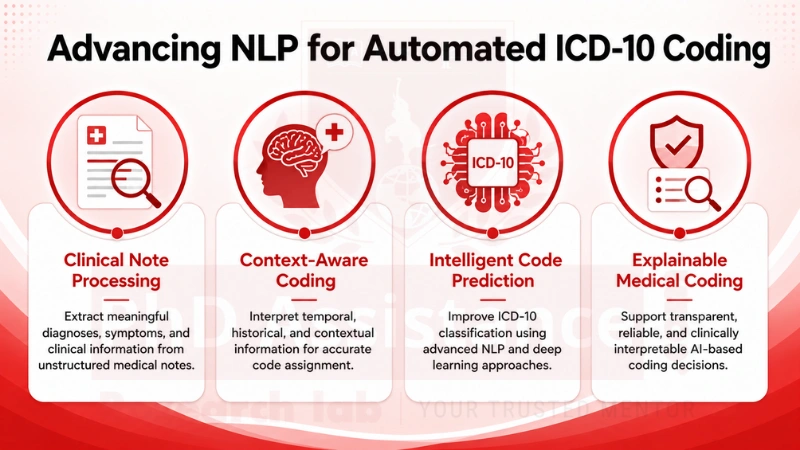
Clinical notes mention conditions that are negated ("no evidence of pneumonia"), historical, suspected or in family members. A coding system that ignores this context assigns wrong codes. ICD-10 is also hierarchical, from chapter to block to category to subcategory, and closely related codes are easily confused. Both are well recognised but remain open in practice.
| Topic | Possible research question | Likely design and data | Why it matters now |
|---|---|---|---|
| Context-aware coding: negation, temporality and uncertainty | Does explicitly modelling negation, history and uncertainty reduce false-positive codes compared with a baseline that ignores context? | Annotation of context on a sample of notes; models with and without context features; error analysis of false positives | Wrong codes from negated or historical mentions affect billing and statistics |
| Hierarchy-aware ICD-10 classification | Does using the ICD-10 hierarchy during training reduce errors between sibling codes, particularly when training data are limited or noisy? | Comparison of flat and hierarchical models; errors measured by distance in the code tree | Errors between related codes are common, and national transitions to ICD-11 raise mapping questions |
Theme 3: Explainability, coders and generalisation
Coders and auditors need to see why a code was suggested. Surveys of explainable AI in healthcare describe many techniques but limited evaluation with users (Chaddad et al., 2023). Evidence on assistance is emerging: in a crossover randomised trial with professional coders in Norway and Sweden, an AI-assisted tool reduced median coding time for complex notes, with no significant change in accuracy (Chomutare et al., 2024). Generalisation is a further concern: models developed on Thai discharge summaries performed differently when validated on United States intensive care data (Ponthongmak et al., 2023).
| Topic | Possible research question | Likely design and data | Why it matters now |
|---|---|---|---|
| Evidence extraction for explainable coding | Do highlighted text spans supporting each suggested code help coders verify suggestions more accurately than suggestions without evidence? | Model with evidence extraction; within-subject user study with coders; accuracy, time and trust measures | Explanation methods are seldom tested with the professionals who use them (Chaddad et al., 2023) |
| Coder-in-the-loop coding and external validation | How do accuracy and coding time change when coders work with an assistant across two hospitals, and how much does the model degrade on the second site? | Two-site study: development at one site, external validation and coder study at the other | Assistance helps on complex notes (Chomutare et al., 2024); transfer between settings is uncertain (Ponthongmak et al., 2023) |
How to test a topic before you commit
Run each candidate through the FINER criteria: feasible, interesting, novel, ethical and relevant (Hulley et al., 2013). For clinical NLP, four checks matter most.
- Data access: public de-identified data sets need credentialed access; hospital notes need ethics and data governance approval.
- Label quality: routine codes contain errors; plan how you will judge the reference standard (Weiskopf & Weng, 2013).
- Users: topics with a user study need access to professional coders.
- Novelty: search recent clinical NLP venues; the field moves quickly.
Illustrative example (hypothetical). A candidate starts with "deep learning for ICD-10 coding". Her partner hospital can share de-identified discharge summaries but has few coders available for a user study. She narrows the topic to: "Does modelling negation and history reduce false-positive respiratory codes in discharge summaries from one hospital, and does the gain hold on a public data set from another country?" The question names one code group, one error type, a baseline and an external test, and it does not depend on recruiting coders.
See PhD topic selection and gap identification. Related lists: edge computing in healthcare and AI in brain disorder diagnosis.
Common mistakes
- Reporting only micro-averaged scores, which hide poor rare-code performance.
- Treating routine codes as perfect ground truth.
- Testing on the same hospital's data used for training and claiming generalisation.
- Building an "explainable" system without testing explanations with coders.
- Underestimating the time needed for data access and ethics approval.
Key takeaways
- Long, redundant notes and changing code sets make automated coding hard (Venkatesh et al., 2023).
- Rare codes and scarce labels remain the central data problems (Kaur et al., 2021).
- AI assistance can save coders time on complex notes, but accuracy gains are not yet shown (Chomutare et al., 2024).
- External validation is essential because performance shifts between settings (Ponthongmak et al., 2023).
- Check data access, label quality and ethics before committing (Hulley et al., 2013; Weiskopf & Weng, 2013).