
How to use this list
This page is for doctoral researchers in management, information systems and sustainability who want a topic on generative AI that is current and feasible. The topics now fall into three themes: generative AI and sustainability-oriented innovation, responsible AI governance, and adoption by small and medium-sized enterprises (SMEs).
Read each row as a starting point. The columns give a possible research question, the design and data it would most likely need, and why the topic matters now. Before you commit, read the sources cited for the theme and check what has been published since. If you are still choosing a broad area, start with how to choose a PhD topic. For wider business topics see business dissertation topics; for ethics and accountability in digital firms see digital responsibility topics.
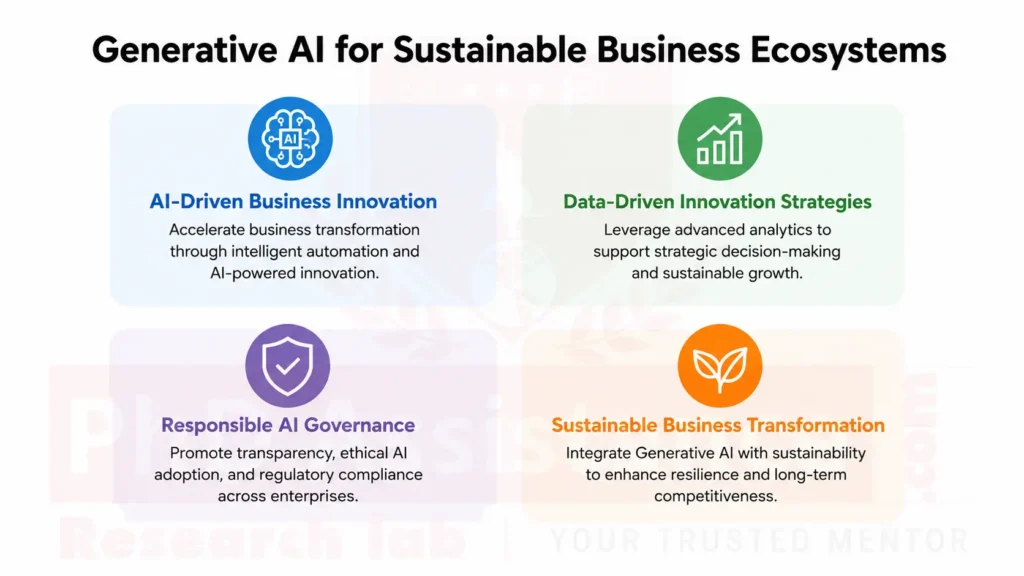
Theme 1: Generative AI and sustainability-oriented innovation
| Topic | Possible research question | Likely design and data | Why it matters now |
|---|---|---|---|
| Generative AI and sustainability-oriented innovation in a business ecosystem | How do firms in one ecosystem (for example a supplier network or digital platform) use generative AI to develop products, services or processes with lower environmental impact, and what conditions enable this? | Multiple case study of four to six firms in one ecosystem; interviews, documents and innovation records | Digital technologies are argued to support sustainable development, but firm-level mechanisms are still being mapped (George et al., 2021) |
| Analytics capability, generative AI use and sustainability performance | Is the use of generative AI associated with sustainability performance, and is the link explained by innovation capability? | Cross-sectional or two-wave survey of firms in one sector; structural equation modelling; matched secondary ESG data where available | Digital transformation has been linked to ESG performance through innovation capability in manufacturing SMEs (Chen & Wang, 2024) |
Evidence that the gap is real. George et al. (2021) describe "digital sustainability" as the use of digital innovation to tackle climate change and sustainable development and set out an agenda for research on how firms actually achieve it. Reviews of digital transformation show that value comes from how organisations change structures and capabilities around a technology, not from the technology alone (Vial, 2019; Warner & Wäger, 2019). Wessel et al. (2025) argue that generative AI changes how value is created on digital platforms, which makes the ecosystem a sensible unit of analysis. Covering national and organisational ecosystems together is too much; one level is enough for a thesis.
Theme 2: Responsible governance of generative AI
| Topic | Possible research question | Likely design and data | Why it matters now |
|---|---|---|---|
| From principles to practice: responsible generative AI governance in large firms | How do firms translate responsible-AI principles (transparency, fairness, accountability, privacy) into policies, roles and review processes for generative AI? | Qualitative multiple case study; interviews with AI, risk and sustainability staff; policy documents | Principles are widely published but their interpretation and implementation vary (Jobin et al., 2019) |
| Governance maturity, trust and generative AI adoption | Is the maturity of a firm's AI governance associated with employee trust in, and use of, generative AI tools? | Survey of employees across several firms with a governance maturity index; multilevel modelling | Opportunities and risks of generative AI for practice and policy remain contested (Dwivedi et al., 2023) |
Evidence that the gap is real. Jobin et al. (2019) analysed 84 AI ethics guidelines and found convergence on a few principles, especially transparency, justice and fairness, non-maleficence, responsibility and privacy, but marked differences in how they were interpreted and few details on implementation. Dwivedi et al. (2023) gathered multidisciplinary views on generative AI and highlighted unresolved questions about accountability, bias and organisational policy. Studying how firms move from principle to practice is therefore a live gap; for corporate governance more broadly, see governance topics.
Theme 3: Generative AI adoption in SMEs
| Topic | Possible research question | Likely design and data | Why it matters now |
|---|---|---|---|
| Generative AI adoption and sustainable transformation in SMEs | Which organisational factors (skills, resources, leadership, perceived risk) predict SME adoption of generative AI, and does adoption relate to measurable sustainability practices? | Survey of SMEs in one country or sector based on an adoption framework; follow-up interviews | SME adoption depends on organisational and environmental conditions that differ by context (Thomas et al., 2025) |
| Barriers to generative AI in small firms: capability, cost and regulation | How do SME owners weigh capability gaps, integration costs and regulatory uncertainty when deciding whether to adopt generative AI? | Qualitative interviews or a discrete choice experiment with SME decision-makers | Opportunities for SMEs are described alongside significant challenges (Bran et al., 2025) |
Evidence that the gap is real. Bran et al. (2025) discuss opportunities, challenges and strategic implications of generative AI for sustainable innovation in SMEs, while Thomas et al. (2025) examine the determinants of AI adoption intention among SMEs in the United Arab Emirates.
How to test a topic before you commit
Run each candidate through the FINER criteria: is it feasible, interesting, novel, ethical and relevant (Hulley et al., 2013)? Then apply the general method in how to choose a PhD topic and how to select a PhD topic, or use our topic selection support. For this field, three checks matter most.
- Access: can you reach enough firms or employees? Company surveys often have low response rates.
- Measurement: define "sustainability" in measurable terms (for example energy use, waste, ESG scores) before you collect data.
- Pace of change: tools change quickly, so frame the question around organisational behaviour rather than one product version.
Worked example (illustrative). A researcher starts with the live title "Generative AI-driven data-driven innovation strategies for sustainable business transformation". She narrows it to one relationship: among food manufacturers in one country, is generative AI use in product development associated with packaging waste reduction, and does innovation capability explain the link? The design becomes a two-wave firm survey matched to reported waste data, with interviews in six firms to explain the pattern. The study is now feasible within a funded doctorate and makes no claims it cannot test.
Common mistakes
- Writing a title that strings together every keyword in the field instead of stating one relationship.
- Proposing a "framework" without saying how it will be tested or by whom.
- Mixing national, ecosystem and firm levels in one study.
- Using "sustainability" without defining how it will be measured.
- Assuming benefits of generative AI rather than testing them, especially for small firms.
Key takeaways
- Digital sustainability is an active research agenda, but firm-level mechanisms linking generative AI to sustainability outcomes are still being mapped (George et al., 2021).
- Value from digital technology comes from organisational change, so study capabilities and processes, not tools alone (Vial, 2019; Warner & Wäger, 2019).
- AI ethics principles converge on paper but diverge in practice, which makes implementation a researchable gap (Jobin et al., 2019).
- SME adoption of generative AI is shaped by context and constraints, so benefits should be tested, not assumed (Thomas et al., 2025; Bran et al., 2025).
- Screen every shortlisted topic for feasibility, novelty, ethics and relevance (Hulley et al., 2013).