
Who this list is for
This list is for doctoral researchers in microbiology, biotechnology, pharmacy or biomedical science who want to work on CRISPR-based editing applied to microbial communities and antimicrobial products.
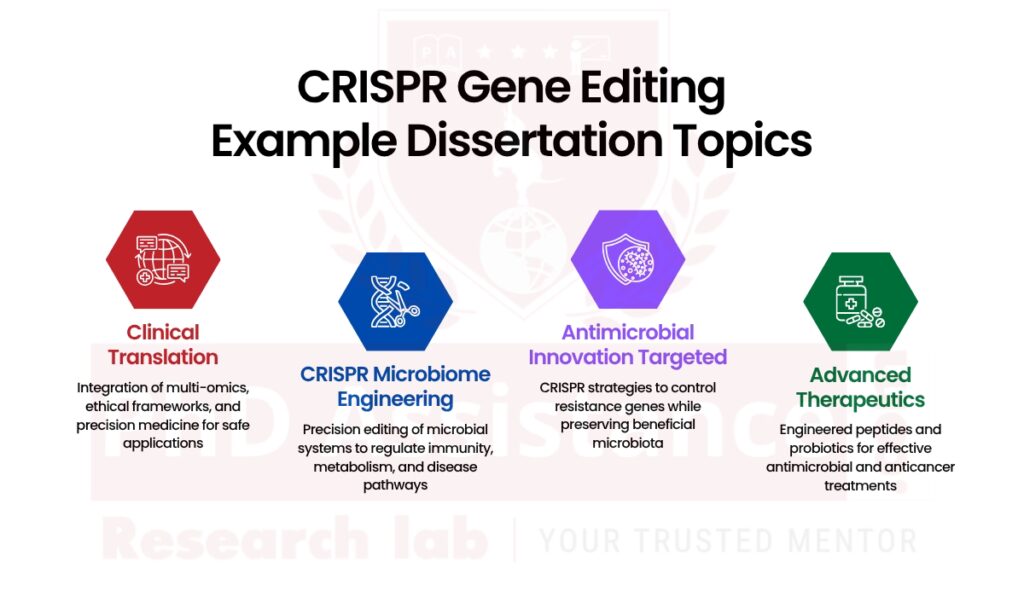
CRISPR-Cas systems made programmable editing routine in many organisms (Doudna & Charpentier, 2014), and the applied literature has moved on to harder problems: getting the machinery to the right cells, measuring specificity honestly, and deciding what can responsibly be released or administered. Amen et al. (2025) review how CRISPR-based editing and antimicrobial peptides are being combined against antibiotic resistance and cancer, and they are clear that delivery, ecological effects and regulation are the main obstacles to clinical use. The rows below follow those obstacles, because that is where a doctorate can contribute.
How to use this list
Treat each row as a starting point, not a finished title. Read the review and the primary papers it cites in your chosen theme, then check what has appeared since. The tables give a possible research question, the design and data it would most likely need, and why the topic matters now. If you are still choosing a broad area, start with how to choose a PhD topic and how to select a PhD topic. Neighbouring lists cover biology, network biology, ribosomal epitranscriptomics and bioethics.
Theme 1: Getting the editing machinery to the target
Delivery is the bottleneck in almost every applied editing project, and in a mixed microbial community it is also a specificity problem: a treatment that reaches every organism equally will remove useful members along with the target. A doctorate can make real progress here by taking one platform, one target organism and one measurable specificity outcome.
| Topic | Possible research question | Likely design and data | Why it matters now |
|---|---|---|---|
| Phage-based delivery of a CRISPR construct to one target species | Can an engineered bacteriophage deliver a CRISPR construct to one target species in a defined mixed community, and what proportion of non-target members is affected? | Phage engineering and host-range characterisation; defined synthetic community in vitro; sequencing of community composition before and after treatment; quantification of editing efficiency | Delivery specificity is named as a central obstacle to microbiome-targeted editing (Amen et al., 2025) |
| Nanoparticle formulation and specificity in a defined community | How do formulation variables affect delivery efficiency and off-target editing in a defined microbial community? | Factorial formulation study with physicochemical characterisation; editing efficiency and off-target assessment by targeted and whole-genome sequencing | Formulation work is often reported without an off-target measurement, which limits comparison (Amen et al., 2025) |
Decide early how you will report specificity. An editing efficiency figure without a matched off-target assessment is not interpretable, and examiners will ask which sequencing depth and which detection limit sit behind your claim. Say what the method cannot see.
Theme 2: Engineered microbes as production and delivery hosts
The second strand uses editing as a tool rather than studying it as an object: engineering microbial hosts to make antimicrobial peptides, or engineering probiotic strains to produce a therapeutic payload in a defined environment. Both are established research programmes with documented industrial obstacles, including biosafety, effects on the resident microbiota and the regulatory status of genetically modified organisms (Wang et al., 2025).
| Topic | Possible research question | Likely design and data | Why it matters now |
|---|---|---|---|
| Engineering a production host for an antimicrobial peptide | Which genetic modifications increase yield and proteolytic stability of one antimicrobial peptide in one production host, and what is the effect on activity against defined resistant isolates? | Strain engineering with defined modifications; quantification of yield and stability; minimum inhibitory concentration testing against a documented isolate panel; cytotoxicity assays | Stability and bioavailability are the reported limits on peptide use, not discovery (Amen et al., 2025; Wang et al., 2025) |
| A probiotic chassis with environment-responsive payload expression | Can a probiotic strain be engineered to express a peptide payload only under defined environmental conditions, and does the response hold in an animal model? | Promoter and circuit design with in vitro characterisation; colonisation and expression measurement in an animal model under approved protocols; immune and microbiota readouts | Conditional expression is the mechanism proposed to limit systemic exposure, and it needs direct testing (Amen et al., 2025) |
Keep the claims proportionate to the model. An in vitro induction result is not evidence of tumour-specific activity in a patient, and an animal study is not a comparison with standard care. State the translational distance in the discussion rather than leaving it to the examiners.
Theme 3: Function, ethics and responsible release
One is functional: using editing to test which microbial genes matter in a defined disease context, which is a screening question with an integration problem attached (Hasin et al., 2017). The other is a governance project: documenting how editing applications are regulated and what criteria would have to be met before release or administration. The second belongs in a social science or policy doctorate and should be designed as empirical work, not as an essay.
| Topic | Possible research question | Likely design and data | Why it matters now |
|---|---|---|---|
| CRISPR screening to test candidate microbial functions in one disease context | Which candidate microbial genes, identified from existing multi-omics data, change a measurable host or community phenotype when disrupted? | Candidate selection from published datasets; pooled or arrayed CRISPR interference screen in a tractable system; validation of hits in isogenic strains (Hasin et al., 2017) | Sequencing studies generate associations faster than functional tests can check them (Amen et al., 2025) |
| Regulatory and ethical criteria for engineered microbial therapeutics | How do regulators in two or three jurisdictions treat engineered live microbial products, and which criteria do practitioners and reviewers regard as decisive? | Document analysis of regulatory frameworks and approvals, with interviews of regulators, researchers and ethics committee members; comparison with the criteria used for genetically modified organisms in agriculture (Chavhan et al., 2025) | The review identifies the absence of settled regulatory pathways as a barrier to translation (Amen et al., 2025) |
| Containment and ecological risk assessment for engineered strains | What containment strategies are available for engineered live strains, and how are their failure rates measured and reported? | Systematic review of containment designs and reported escape or transfer rates, with a laboratory test of one strategy if facilities allow | Ecological effects of released or administered engineered organisms are an acknowledged open question (Amen et al., 2025) |
For the screening row, choose the candidate list from published data before you build the library, and pre-register the hit criteria. For the governance rows, read the primary regulatory texts and the approval records rather than commentary, and expect ethics approval for the interview component.
How to test a topic before you commit
Run each candidate through the FINER criteria: feasible, interesting, novel, ethical, relevant (Hulley et al., 2013). Five checks decide most projects in this area.
- Containment and approvals: confirm the biosafety level, the institutional approvals and, for animal work, the licences, before the proposal is written.
- Measurement: name the efficiency and specificity assays and their detection limits.
- Model fit: match the claim to the model; in vitro, animal and clinical statements are not interchangeable.
- Scope: one platform, one target, one outcome. Bundling three into each topic makes it hard to answer.
- Gap statement: write the gap as a specific unanswered question with citations, using a structured method rather than asserting novelty (Müller-Bloch & Kranz, 2015).
For turning the chosen row into a problem statement and proposal, see problem identification, gap identification and the research proposal.
Common mistakes
- Writing a title that covers delivery, engineering, screening and ethics in one project.
- Reporting editing efficiency without a matched off-target assessment.
- Describing in vitro or animal results as though they showed clinical benefit.
- Promising a regulatory framework; a doctorate can document, compare and propose criteria.
- Treating an association from microbiome sequencing as a causal mechanism (Hasin et al., 2017).
- Underestimating the time needed for biosafety and animal approvals.
Key takeaways
- Delivery specificity, not editing chemistry, is the limiting step in microbiome-targeted applications (Amen et al., 2025).
- Engineered production hosts and probiotic chassis are credible doctoral projects when yield, stability and activity are named as outcomes (Wang et al., 2025).
- Functional screening turns microbiome associations into testable claims; multi-omics integration has to be planned first (Hasin et al., 2017).
- Regulatory and containment questions are empirical projects, not essays, and can draw on the agricultural gene-editing experience (Chavhan et al., 2025).
- Keep every claim at the level the model supports, and test each candidate topic for approvals, measurement and scope (Hulley et al., 2013).