
Who this list is for
Predictive systems now support decisions on credit, hiring, insurance, health care and public services. When the data or design choices behind them are skewed, they can treat groups of people differently in ways that are hard to see and harder to challenge. Research on algorithmic bias asks how such differences arise, how to measure them and what reduces them without creating new harms. Surveys of the field show how many definitions and techniques now exist, from fairness in search and recommendation (Ekstrand et al., 2022) to bias in large language models (Gallegos et al., 2024).
This list is for doctoral researchers in computer science, data science and information systems.
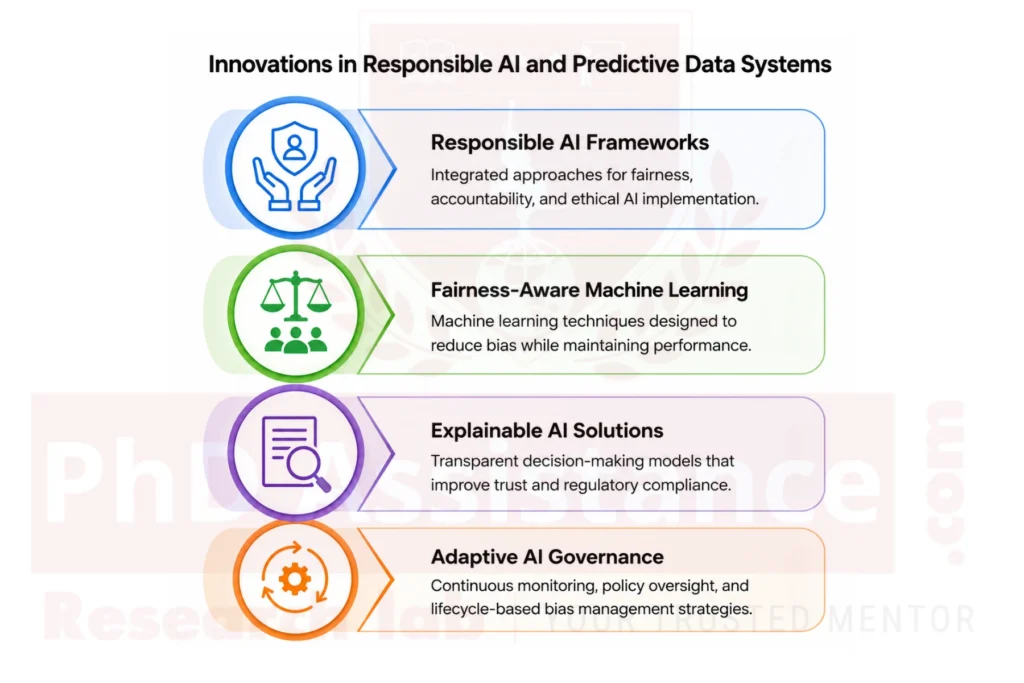
How to use this list
Choose a domain first (lending, recruitment, a clinical task), because fairness depends on the decision, the people affected and the law that applies. Then choose a stage of the AI lifecycle to study. If you are still deciding on an area, start with how to choose a PhD topic. A related list covers ethical AI in trading systems.
Theme 1: Bias across the AI lifecycle
Bias can enter at data collection, labelling, feature choice, training and deployment, and mitigation methods are usually grouped by where they act: before training (pre-processing), during training (in-processing) or on the model's outputs (post-processing). A strong reason to study the later stages is that fairness does not always travel. Yang et al. (2024) found that medical imaging models encoded demographic attributes and used them as shortcuts, and that fairness achieved on training data often failed to hold at new test sites.
| Topic | Possible research question | Likely design and data | Why it matters now |
|---|---|---|---|
| Comparing pre-, in- and post-processing bias mitigation in one predictive domain | In a defined task such as credit default prediction, which mitigation stage reduces a chosen group disparity most, and at what cost to accuracy and calibration? | Controlled experiments on public benchmark data and, if possible, one organisational dataset; several fairness metrics reported side by side | Mitigation methods have multiplied, but domain-specific comparisons that report trade-offs are still needed (Ekstrand et al., 2022) |
| Fairness drift after deployment: detection and response | How does a model's group-level performance change after deployment as data shift, and which monitoring signals detect harmful drift early? | Retrospective analysis of time-stamped data or simulation of shift; external validation at a second site | Fairness achieved in development may not transfer to new settings (Yang et al., 2024) |
Keep the two topics apart. The first compares methods at one point in time on fixed data; the second follows one model over time and asks how disparities change once it meets real cases. Either is enough for a doctorate, and both need more than one fairness metric reported transparently.
Theme 2: Explainability and fairness
Explanations are often proposed as a route to fairness, because they let people see which features drive a decision. Tools such as SHAP make local explanations of tree-based models practical (Lundberg et al., 2020). Rudin (2019) argues, however, that for high-stakes decisions an inherently interpretable model is often better than a post-hoc explanation of a black box. Whether explanations actually help people notice and correct unfair outputs is an empirical question that suits a doctoral study.
| Topic | Possible research question | Likely design and data | Why it matters now |
|---|---|---|---|
| Do explanations help decision-makers detect unfair model outputs? | When reviewers see post-hoc explanations or an interpretable model, are they more likely to identify biased recommendations, and does their trust become better calibrated? | Randomised online or laboratory experiment with domain users; accuracy of bias detection and trust measures as outcomes | Interpretable models and post-hoc explanations make different promises in high-stakes settings (Rudin, 2019; Lundberg et al., 2020) |
Theme 3: Governance and regulation
Regulation now turns fairness from an aspiration into an obligation in some settings. The EU Artificial Intelligence Act sets requirements for high-risk systems, including data governance and human oversight (European Parliament & Council of the European Union, 2024). Research has also been urged to state its own potential impacts (Olteanu et al., 2023). Practical evidence shows what a full evaluation looks like: Kelly et al. (2026) reported diagnostic accuracy, fairness across groups and implementation findings for AI in NHS breast screening together.
| Topic | Possible research question | Likely design and data | Why it matters now |
|---|---|---|---|
| How organisations turn fairness requirements into practice in business analytics | How do firms that use predictive analytics in recruitment or credit translate fairness and regulatory requirements into data, model and review processes, and where do these processes break down? | Multiple case study: interviews with data scientists, compliance and business staff; document analysis of model governance procedures | High-risk AI systems now face legal requirements on data governance and oversight (European Parliament & Council of the European Union, 2024) |
| Monitoring fairness over time in a high-risk predictive system | Which combination of monitoring metrics, review triggers and human oversight keeps group-level performance within agreed limits in one high-risk use case? | Design science study: build and evaluate a monitoring procedure with a partner organisation or on realistic simulated data; expert evaluation | Evaluations that report accuracy, fairness and implementation together are now expected (Kelly et al., 2026) |
How to test a topic before you commit
- Data: fairness analysis needs group information (for example sex or age), which raises legal and ethical questions; confirm you can obtain and use it.
- Metric: choose and justify a fairness definition for your decision before you run experiments.
- Comparison: compare against a reasonable baseline, not an untreated model alone.
- Scope: one domain, one decision and one stage of the lifecycle is enough for a doctorate.
For more, see how to select a PhD topic and topic selection.
Common mistakes
- Proposing an "integrated framework" for every sector instead of testing one approach in one domain.
- Reporting a single fairness metric without explaining why it fits the decision.
- Claiming that fairness can be improved without any cost; report the trade-offs you observe.
- Evaluating only on one dataset and assuming the result will hold elsewhere.
- Citing sources about human cognitive bias when the topic is algorithmic bias.
Key takeaways
- Fairness research is now broad enough that a thesis must pick one domain, decision and lifecycle stage (Ekstrand et al., 2022; Gallegos et al., 2024).
- Fairness achieved in development can fail at new sites, so post-deployment monitoring is a live topic (Yang et al., 2024).
- Interpretable models and post-hoc explanations offer different routes to accountability (Rudin, 2019; Lundberg et al., 2020).
- Regulation of high-risk AI makes governance research practical as well as academic (European Parliament & Council of the European Union, 2024).
- Report accuracy, fairness and implementation together, and state the impacts of your own work (Kelly et al., 2026; Olteanu et al., 2023).