
Who this list is for
This list is for doctoral and LLM researchers in information technology law, health law and data protection, and for health informatics researchers with a legal question. We have titled the page to match its content, narrowed each title to a question one thesis can answer and grouped them into three themes. The Act and the rules made under it are being brought into force in stages, so any study needs a clear cut-off date for the law it analyses.
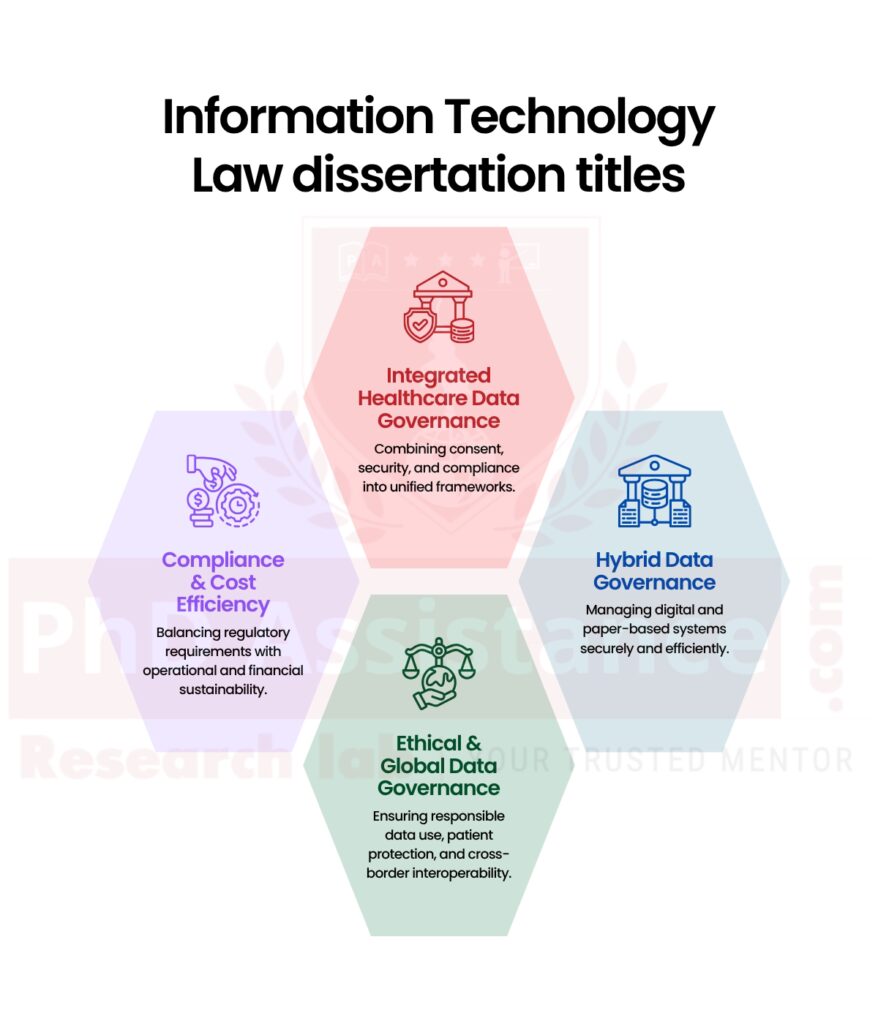
How to use this list
Most strong titles here combine doctrinal analysis, which reads statutes, rules and cases to state what the law requires (Hutchinson & Duncan, 2012), with evidence of how institutions actually comply. Each table gives a title, a research question, the design and data it would need and why it matters now. For other jurisdictions see GDPR and UAE data protection law titles, our notes on the UAE personal data protection law and the Saudi personal data protection law, and the topics hub.
Theme 1: Consent and patients' rights
Commentaries on the Act agree that consent, purpose limitation and patients' rights to access and correct their data are central for health care (Khanna & Kotwal, 2025; Sethi et al., 2026). They also report practical tensions: consent processes can disrupt clinical workflow, and a right to erasure may conflict with the need to keep a continuous clinical record (Sethi et al., 2025). These tensions are where a doctoral study can add evidence.
| Dissertation title | Possible research question | Likely design and data | Why it matters now |
|---|---|---|---|
| Consent under India's Digital Personal Data Protection Act in hospital care: notices, withdrawal and clinical continuity | Do consent notices and withdrawal procedures in a sample of Indian hospitals meet the Act's requirements, and how do hospitals reconcile withdrawal or erasure requests with the duty to keep clinical records? | Doctrinal analysis of the Act and rules; document analysis of hospital consent notices; interviews with data protection and records staff | Commentators identify consent and erasure as points of tension for clinical practice (Sethi et al., 2025; Chail et al., 2026) |
Theme 2: Compliance in practice
Two practical problems recur. Smaller providers may lack the money and staff to comply, and legal terms such as "reasonable" safeguards are not yet defined in practice (Sethi et al., 2025; Sethi et al., 2026). Many providers also run mixed paper and electronic systems, and records move between them. Because the Act applies to digital personal data, including data digitised after collection, the boundary between paper and digital records matters for what the law requires. Data quality frameworks for electronic health records show what is lost when records are converted or shared (Kahn et al., 2016).
| Dissertation title | Possible research question | Likely design and data | Why it matters now |
|---|---|---|---|
| Compliance costs of the DPDP Act for small and medium healthcare providers in India: a mixed methods study | What organisational and financial changes have small and medium providers made to comply with the Act, and which obligations do they find hardest to meet? | Survey of providers in one or two states, followed by case studies; cost categories defined in advance | Costs for smaller providers are a widely raised concern (Sethi et al., 2026; Khanna & Kotwal, 2025) |
| Digitising paper health records under the DPDP Act: legal scope, interoperability and data quality in hybrid record systems | At what point do paper-based health records come within the Act, and what legal and data quality safeguards apply when they are digitised and shared between systems? | Doctrinal analysis of the Act's scope; case study of a hospital digitisation project; data quality assessment of converted records | Hybrid systems are common, and digitisation changes the legal position (Kahn et al., 2016) |
Theme 3: Research use and cross-border transfer
Health research relies on personal data, often from children and other vulnerable groups. In India, ethics committees review such research under national guidelines (Indian Council of Medical Research, 2017), and commentators note the need to balance strict data protection with research and innovation (Khanna & Kotwal, 2025). Cross-border transfer is a second open question: health data increasingly move to cloud and research partners abroad, and neighbouring regimes take different approaches, as the UAE and Saudi laws show (UAE Government, n.d.; Saudi Data & AI Authority, 2023).
| Dissertation title | Possible research question | Likely design and data | Why it matters now |
|---|---|---|---|
| Health research under the DPDP Act: research use of personal data, children's data and ethics committee review | How do the Act's provisions on research use and children's data interact with ethics committee review under national research guidelines, and where do the two leave gaps? | Doctrinal analysis of the Act and ICMR guidelines; interviews with ethics committee members and researchers | Research governance and data protection now overlap (Indian Council of Medical Research, 2017; Khanna & Kotwal, 2025) |
| Cross-border transfer of health data: India's DPDP Act compared with the UAE and Saudi personal data protection laws | How do the three laws regulate transfer of health data abroad, and what do the differences mean for multinational health research and cloud services? | Comparative doctrinal analysis with a fixed cut-off date; optional interviews with compliance professionals | Regional regimes have developed in parallel (UAE Government, n.d.; Saudi Data & AI Authority, 2023), with different approaches to transfer |
Illustrative example. A candidate starts with "a legal framework for healthcare data governance under the DPDP Act". Her supervisor asks what the thesis will add to existing commentary. She narrows it to consent withdrawal in three hospitals in one city, reads the Act and rules as at a fixed date, analyses the hospitals' notices and interviews their records managers. Her reform proposals then rest on evidence rather than on a general framework.
How to test a title before you commit
Apply the FINER criteria: is the study feasible, interesting, novel, ethical and relevant (Hulley et al., 2013)? For legal titles, check that the provisions you need are in force or will be by your cut-off date, that institutions will share documents and staff time, and whether interviews need ethics approval. See how to choose a PhD topic, how to select a PhD topic, PhD topic selection and law doctorates.
Common mistakes
- Promising a complete governance framework instead of answering one legal question.
- Analysing provisions without stating which are in force at the cut-off date.
- Assuming the Act covers paper records that are never digitised.
- Comparing with "global frameworks" rather than named laws on a named issue.
- Relying only on commentary without primary sources or evidence of practice.
Key takeaways
- Consent, erasure and clinical continuity are the clearest tensions for health care under the Act (Sethi et al., 2025; Chail et al., 2026).
- Compliance costs and undefined standards are practical concerns worth studying empirically (Sethi et al., 2026; Khanna & Kotwal, 2025).
- Combine doctrinal analysis with evidence of practice (Hutchinson & Duncan, 2012).
- Digitisation changes both the legal position and the quality of records (Kahn et al., 2016).
- Research governance and cross-border transfer suit focused comparative titles (Indian Council of Medical Research, 2017; UAE Government, n.d.; Saudi Data & AI Authority, 2023).
- Test each title with FINER and fix a legal cut-off date (Hulley et al., 2013).