
Who this list is for
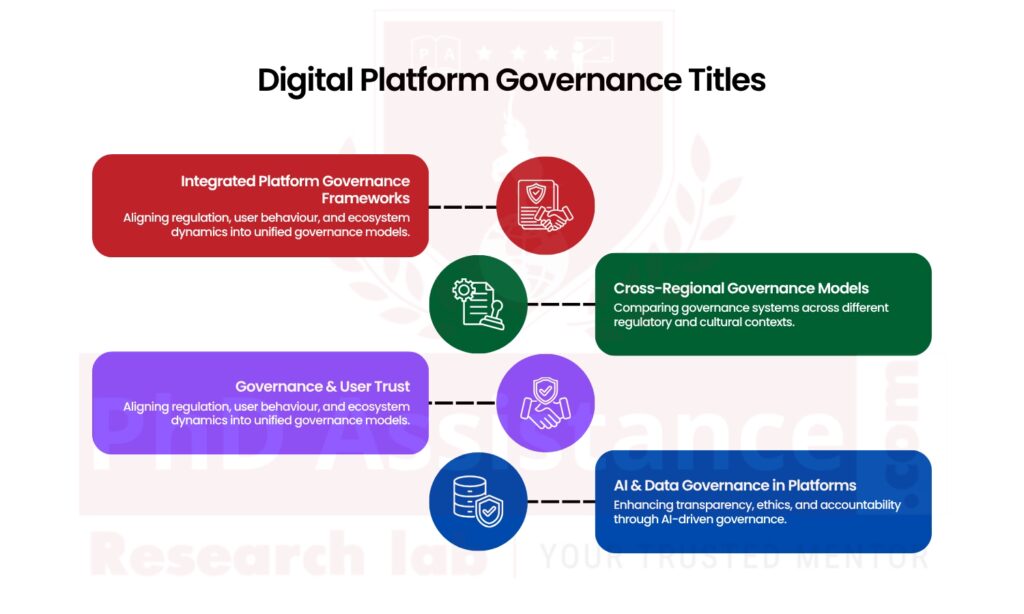
This list is for doctoral and master's researchers in information systems, strategy, marketing, law and public policy who want to study digital platform governance. The term covers two things: the rules a platform sets for the developers, sellers and users in its ecosystem, and the rules governments set for platforms. Pan et al. (2025) review the first literature and set out directions for further work. We narrowed each to one mechanism, one platform type and the data needed, and grouped them into three themes.
How to use this list
Decide first whether your question is about governance by a platform or governance of platforms, then check what data you can obtain: public app marketplace listings, seller pages, terms of service, survey responses or regulatory documents. Each table gives a title, a research question, the likely design and data, and why it matters now. For neighbouring lists see digital responsibility topics, governance in modern enterprises, digital ethics titles and the topics hub.
Theme 1: Platform rules and ecosystem behaviour
Platforms govern by setting access rules, fees, review processes and enforcement. When a platform changes a rule, the change acts as a natural experiment for the developers or sellers who depend on it, which makes rule changes a practical source of evidence. Enforcement is increasingly automated, raising the question of whether automated tools apply rules accurately and consistently.
| Dissertation title | Possible research question | Likely design and data | Why it matters now |
|---|---|---|---|
| App marketplace rule changes and developer behaviour: an event study of complementor responses | How did a specific change in app marketplace rules (for example fees or review policy) affect developers' release frequency, pricing and exit? | Event study or difference-in-differences on public app listing data before and after the change | How platforms govern complementors is a central theme in recent reviews (Pan et al., 2025) |
| Automated enforcement of platform rules: accuracy and consistency of algorithmic removal of fake reviews on an online marketplace | How accurately and consistently does a marketplace's automated system remove reviews that breach its rules, and which sellers are most affected by errors? | Audit study using collected review data and a labelled sample; comparison of removals with rule breaches | Audit methods for algorithmic systems are developing quickly (Laine et al., 2024) |
Theme 2: Users and trust
Marketplaces use seller verification, review policing and dispute resolution to make strangers willing to trade. Whether users notice these mechanisms, and whether they change trust and purchase behaviour, is an empirical question. Surveys that measure both perceived governance and trust from the same respondent at one time are vulnerable to common method bias (Podsakoff et al., 2003), so pair them with an experiment or behavioural data where you can.
| Dissertation title | Possible research question | Likely design and data | Why it matters now |
|---|---|---|---|
| Governance mechanisms and user trust on online marketplaces: seller verification, review policing and dispute resolution | Which visible governance mechanisms increase buyers' trust in unfamiliar sellers, and does that trust translate into purchase decisions? | Online experiment manipulating displayed governance cues, followed by a survey of marketplace users | Trust mechanisms are the core of marketplace governance (Pan et al., 2025), but their effects are rarely tested separately |
Theme 3: Regulation and AI governance
Governments are writing rules for platforms and for the AI systems they deploy. The EU Artificial Intelligence Act sets obligations for AI systems, including transparency duties for some generative AI uses (European Parliament & Council of the European Union, 2024), and it was amended in 2026 (European Parliament & Council of the European Union, 2026), which shows why a thesis needs a fixed cut-off date. Generative AI is also changing the value platforms create (Wessel et al., 2025), while ethics principles alone do not ensure accountable practice (Mittelstadt, 2019).
| Dissertation title | Possible research question | Likely design and data | Why it matters now |
|---|---|---|---|
| One platform, two regimes: how a multinational platform adapts its governance to different national rules | How do a platform's terms, moderation processes and transparency reports differ between two jurisdictions, and which legal requirements explain the differences? | Comparative case study of one platform in two jurisdictions using public documents and reports, with a fixed cut-off date | Holding the platform constant isolates the effect of law (Eisenhardt, 1989) |
| Governing generative AI features on digital platforms: transparency and accountability practices under the EU AI Act | How do platforms that add generative AI features document, label and monitor them, and how closely do their practices match the Act's transparency duties? | Document analysis of disclosures and policies of several platforms, with expert interviews | Generative AI is changing platforms (Wessel et al., 2025) as new AI rules take effect (European Parliament & Council of the European Union, 2024) |
Illustrative example. A candidate begins with "an integrated framework for digital platform governance". Her supervisor asks what data she can see. She finds that a major app marketplace changed its fee structure for small developers on a known date and that listing data are public. She narrows the title to an event study of developer pricing and release activity before and after the change, which gives a clear, testable contribution.
How to test a title before you commit
Apply the FINER criteria: is the study feasible, interesting, novel, ethical and relevant (Hulley et al., 2013)? Check platform terms before collecting data automatically, plan how you will handle personal data in reviews or profiles, and record exact dates for every rule or law you analyse. Before you commit, write down the one mechanism you will study, the population affected by it, the outcome you can observe and the date range of your data. If any of the four is unclear, the title is still too broad. It also helps to read two or three recent empirical studies of a similar platform type and note which data sources and designs they used, since these show what is realistic within a doctoral timeline. See how to choose a PhD topic, how to select a PhD topic, PhD topic selection and business dissertation topics.
Common mistakes
- Trying to link regulation, user behaviour and ecosystem dynamics in one thesis.
- Choosing outcomes such as platform revenue that only the platform can observe.
- Comparing "regions" rather than named jurisdictions and a named platform.
- Analysing a law without a cut-off date while it is still being amended.
- Collecting platform data without checking terms of service and data protection duties.
Key takeaways
- Platform governance covers rules set by platforms and rules set for platforms; choose one (Pan et al., 2025).
- Rule changes offer natural experiments for studying ecosystem behaviour.
- Test trust effects with designs that reduce common method bias (Podsakoff et al., 2003).
- Automated enforcement can be audited like other algorithmic systems (Laine et al., 2024).
- AI governance titles need a fixed cut-off date because the rules are changing (European Parliament & Council of the European Union, 2024; European Parliament & Council of the European Union, 2026; Wessel et al., 2025).
- Principles are not practice; study what platforms actually do (Mittelstadt, 2019; Eisenhardt, 1989; Hulley et al., 2013).