Digitising Colonial-Era Manuscripts: Metadata Standards for Postcolonial Literary Archives
Info: Digitising Colonial-Era Manuscripts: Metadata Standards for Postcolonial Literary Archives Topics I phdassistance.com
Published: 18th July in Digitising Colonial-Era Manuscripts: Metadata Standards for Postcolonial Literary ArchivesTopics I phdassistance.com
Share this:
Related Services
Our academic writing and marking services can help you
Introduction
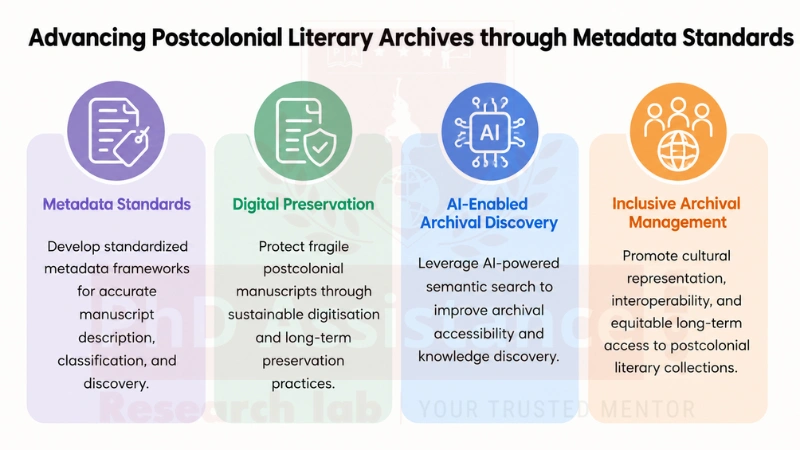
The fast-paced development of technologies in the digital environment has brought about new ways of managing, preserving and ensuring the availability of historical archives by cultural heritage organisations. Libraries, archives and museums have turned towards adopting digital methods of keeping literary works safe and making them more accessible to researchers and the general audience. Digitising Colonial-Era Manuscripts is an important project that focuses on the safekeeping of historical documents as well as on their integration into digital archives. Nonetheless, the success of such initiatives largely depends on the adoption of standardised metadata approaches aimed at the proper description of the content, historical significance and cultural value of manuscripts. Even though there is a lot of progress being made, the following difficulties still stand in the way of managing digital manuscript collections – inconsistent metadata approaches, lack of interoperability between the archival systems, absence of postcolonial viewpoints and lack of frameworks for the long-term preservation of the material. Thus, there is a growing need for a metadata approach in digitising colonial-era literary manuscripts.
Proposed PhD Topic 1: Designing Metadata Standards for the Digitisation of Colonial-Era Manuscripts in Postcolonial Literary Archives
Background Context:
With the development of the humanities, the preservation and accessibility of the historical literary collections have been revolutionised due to digitisation initiatives. Digital paper Preservation becomes a necessary method not only for preserving fragile colonial literary texts but also for providing broad public access to the culturally valuable sources. However, digitisation is not simply a process of transferring the textual material from one form to another. It requires a successful use of Metadata Standards for the description and organisation of the archives. The creation of metadata becomes extremely important in the case of Postcolonial Archives since the choice of metadata has a considerable impact on the way colonial history, culture, and narrative can be interpreted. Unfortunately, despite all technological advancements, many archivists are still using methods that fail to consider the context, the cultural aspect and equity of the archive.
PhD-Level Verification:
The current literature mostly deals with the technical aspects of digitisation and online availability of documents, and little research has been conducted on the political and cultural consequences of creating the metadata. The current literature has done little to integrate metadata systems that facilitate equal representation, preservation and cultural availability in Postcolonial Archives.
Research Questions:
Contributions at the PhD-Level:
Suggested Readings:
Zaagsma, G. (2023). Digital History and the Politics of Digitization. Digital Scholarship in the Humanities, 38(2), 830–851.
Proposed PhD Topic 2: Developing Community-Driven Decolonial Archival Frameworks for the Preservation of Colonial-Era Literary Manuscripts
Background Context:
Digitisation of colonial-period manuscripts has broadened possibilities for preserving and accessing literary historical archives. With Digital Preservation, cultural heritage organisations can preserve and make available to an international audience delicate documents. But many of the existing digital archives keep repeating colonial structures of documentation which marginalise the voices of local cultures and support dominant historical stories. In Digital Humanities, the realisation that digitisation is not enough to rectify the biases present in historical literature unless the process is aided by metadata that reflect cultural diversity and different understandings of history is becoming widespread. The development of Postcolonial Archives is resulting in an increased demand for metadata systems that promote equality and participatory and transparent archival processes.
PhD-Level Verification:
Current studies examine archival decolonisation, digital archiving, and community involvement separately. But not many scholars have explored the use of Decolonial Theory and Meta Standards to create a holistic framework for archives that include multiple provenances and community custodianship in Postcolonial Archives. This is a critical area of study that provides an important research question for doctoral study.
Research Questions:
PhD-Level Contributions:
Suggested Readings:
Jeurgens, C., & Karabinos, M. (2020). Paradoxes of Curating Colonial Memory. Archival Science, 20, 199–220.
Proposed Dissertation topic 3: Artificial Intelligence-Driven Semantic Retrieval and Knowledge Discovery for Digitised Colonial Literary Manuscript Collections
Background Context:
The development of modern AI has brought about major changes in the way researchers utilise digitised historical collections. The development of large language models, semantic searches, and retrieval-augmented generation (RAG) has facilitated better information search through natural language searches in digital archives. The emergence of these technologies is a great boost for the Humanities, especially concerning the accessibility of manuscripts from the colonial era. The effectiveness of retrieval systems still greatly relies on the quality of metadata that remains inconsistent in archival institutions. In Postcolonial Archives, inconsistent metadata structure lowers search accuracy, prevents the semantic understanding of the content and limits access to historical documents. Improvement of Archival Metadata Management with an AI-based metadata framework will facilitate intelligent discovery as well as ensure sustainability of Digital Preservation.
PhD Level Verification:
Research has shown the efficiency of using AI, semantic search, and retrieval augmentation in enabling historical archival access. There is, however, little work that combines intelligent search techniques with a metadata framework that enables semantic interoperability, contextualization, and digital preservation in postcolonial archives. This provides a great chance to research developing an AI-enabled metadata framework.
Research Questions:
PhD-Level Contributions:
Suggested Readings:
Chaudhari, A. V. (2025). Reimagining finance with artificial intelligence: Smart technologies reshaping the digital economy. ESP Journal of Engineering & Technology Advancements, 5(2), 47–61. https://doi.org/10.56472/25832646/JETA-V5I2P107.
Proposed Dissertation Topic 4: Reimagining Postcolonial Literary Archives through Collaborative Digital Heritage and Participatory Archival Ecosystems
Background Context:
The advent of the digitisation of archives has led to the emergence of the opportunity to preserve and disseminate cultural heritage along with enhancing public involvement. It should be noted that in the Humanities, the understanding of the importance of not only preserving archival documents but also representing voices, knowledge, and experiences of the communities linked to them has become widespread. However, even though Digital Preservation has positively affected the accessibility of the manuscripts of colonial times, the process of creating the majority of digital archives has been based on traditional models, which offer restricted possibilities for the involvement of the community in metadata generation and the archival process itself. Along with the increasing popularity of Postcolonial Archives, there is a necessity to develop Meta Standards for collaborative knowledge creation, cultural sensitivity, and shared authority.
PhD-Level Verification:
The present literature identifies the need for participatory archives, indigenous knowledge systems, and community management in the archival process. However, there is very little research that has designed an Integrated Metadata Standard, which allows community participation while at the same time providing archival consistency, interoperability, and digital preservation in Postcolonial Archives. This gap in the literature offers a good opportunity for conducting doctoral research.
Research Questions:
Contributions at the PhD-Level:
Suggested Readings:
Henning, T. F. (2024). Review of Decolonial Archival Futures. Journal of Contemporary Archival Studies, 11, Article 9.
Proposed Dissertation Topic 5: Developing an Interoperable Framework for Sustainable Digital Manuscript Preservation across Cultural Heritage Repositories
Background Context:
The fast growth in digital archives has changed how the preservation and distribution of the historical literature archive is done within libraries, museums, and other cultural institutions. Through Digital Preservation, it is possible to preserve the colonial era manuscript and, at the same time, making it more accessible. The different structure of the metadata, as well as archival procedures, has made it difficult to collaborate and discover more about the digital archive. In the humanities, it has been very significant to develop metadata standards for the exchange and preservation of data resources. Despite all these efforts, Postcolonial Archives still face problems in metadata management, which make the archival process not consistent enough. Through an interoperable Metadata Management System, it will be easier to collaborate and share information.
PhD-Level Verification:
Past research focuses on the application of metadata, archiving, and interoperability individually. Nevertheless, there is a lack of literature that examines the interplay between Meta Standards, Interoperability Standards, and Metadata Management in the development of Postcolonial Archives. In addition, there is inadequate empirical evidence about the advantages of meta standards in digital collaboration and manuscript preservation.
Research Questions:
PhD-Level Contributions:
Suggested Readings:
As’ad, M., Indrawardani, K. F., Cahyaningrum, G. A., & Kamajati, D. (2025). Archival Metadata Practices and Challenges in Managing Digital Manuscripts. Record and Library Journal, 11(2), 359–373.
Need assistance finalising your dissertation topic in Digitising Colonial-Era Manuscripts? Selecting a strong, researchable topic can be challenging — but you don’t have to do it alone.
Our research consultants can help refine your ideas, identify literature gaps, and guide you toward a topic that aligns with current academic trends and your programme requirements.
Contact us to begin one-on-one topic development and refinement with PhdAssistance.com Research Lab.
Share this:
Cite this work
PhDAssistance. (n.d.). Cybersecurity in business Dissertation Topics Retrieved January 28th, from https://phdassistance.com/topic/cybersecurity-business/
Jalolova, M., and Musawwir, M. “Cybersecurity in business Dissertation Topics for PhD Scholars.” PhDAssistance, https://phdassistance.com/topic/cybersecurity-business/ Accessed 28th January 2026.
Jalolova, M., and Musawwir, M. “Cybersecurity in business Dissertation Topics for PhD Scholars.” PhDAssistance, PhDAssistance, Web. 28th January 2026.
Jalolova, M., and Musawwir, M., n.d. Cybersecurity in business Dissertation Topics for PhD scholars. [online] Available at: https://phdassistance.com/topic/cybersecurity-business/ [Accessed 28th January 2026].
Jalolova M., Musawwir M. Cybersecurity in business Dissertation Topics for PhD scholars [Internet]. PhDAssistance; [cited 2026 28th January]. Available from: https://phdassistance.com/topic/cybersecurity-business/
Jalolova, M., and Musawwir, M. (n.d.). Cybersecurity in business Dissertation Topics for PhD scholars. Retrieved 28th January 2026, from https://phdassistance.com/topic/cybersecurity-business/
Jalolova, M., and Musawwir, M., Cybersecurity in business Dissertation Topics (n.d.) https://phdassistance.com/topic/cybersecurity-business/ accessed 28th January 2026.
Study Resources
Free resources to assist you with your university studies!