
Cultural Intelligence in Virtual Leadership for Global Hybrid Workplaces Dissertation Topics I phdassistance.com
Info: Cultural Intelligence in Virtual Leadership for Global Hybrid Workplaces Dissertation Topics I phdassistance.com
Published: 09th june in Cultural Intelligence in Virtual Leadership for Global Hybrid Workplaces Dissertation Topics I phdassistance.com
Share this:
Related Services
Our academic writing and marking services can help you
Introduction
The increased use of hybrid and remote work models has changed organisational communication, collaboration, and leadership styles in a major way. With the increasing geographical and cultural diversity of most organisations, the role of Cultural Intelligence has gained relevance as a tool for managing multicultural teams, creating employee engagement, and improving organisational performance. Leaders today find themselves in need of using their knowledge of cultural differences to create trust and inclusion among people working remotely and in collaboration through digital networks. While there is increasing research interest in hybrid work and virtual leadership, there is very little literature on the influence of Cultural Intelligence in Virtual Leadership on employee engagement, team performance, and leadership effectiveness.
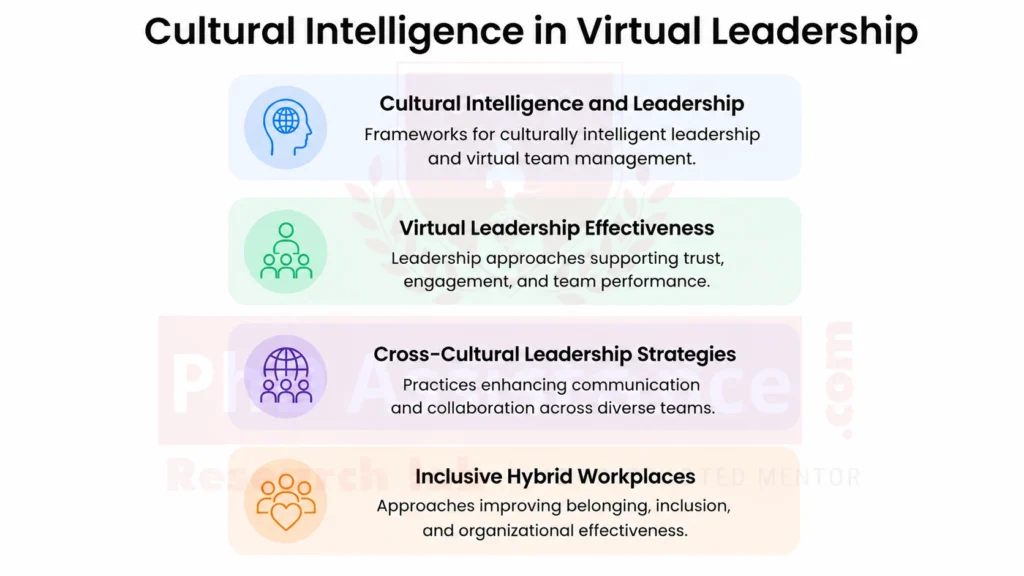
Proposed PhD Topic 1: Cultural Intelligence-Driven Leadership Frameworks for Enhancing Employee Belonging in Global Hybrid Workplace
Background Context:
Growing trends towards Global Workplaces have changed the face of organisational communication, collaboration, and engagement. Even though hybrid work comes with its strengths, hybrid workplaces bring about issues pertaining to employees’ sense of belonging, inclusion, and connectivity. From the findings in the study by Sammalisto (2026), communication, cultural barriers, and collaborative barriers are some of the experiences that are likely to be encountered by managers when dealing with a multicultural workforce. The current situation regarding the diversity of employees has necessitated the use of cultural intelligence. Very few studies have noted the influence of culturally intelligent leadership on belonging and inclusion of employees in hybrid organisations.
PhD-Level Verification:
Many previous studies have examined cultural intelligence, leadership efficiency, and employee belongingness as separate topics. However, there are very few empirical investigations on how the two—Cultural Intelligence and Leadership—can be combined to enhance employee belongingness and engagement in Global Hybrid Working Environments. There remain issues associated with social isolation, invisibility, and participation in current hybrid workplaces.
Research Questions:
PhD-Level Contributions:
Suggested Readings:
Sammalisto, P. (2026). Leadership Challenges in Multicultural Teams: The Role of Cultural Intelligence.
Proposed PhD Topic 2: Virtual Leadership Effectiveness and Trust Development in Global Hybrid Workplace
Background Context:
The adoption of hybrid and remote working styles has led to an increase in the importance of Leadership Effectiveness while leading teams that are spread across different geographical locations. Companies rely heavily on various digital communication systems to collaborate and make decisions. As pointed out by Judeu, Tărău, and Birta (2025), borderless teams tend to have problems associated with a lack of trust, poor communication, and team unity since geographical distances make direct interactions difficult. It follows, therefore, that virtual leadership practices are crucial to establishing trust, collaboration, and effective teamwork.
PhD-Level Verification:
There have been numerous studies on both virtual leadership and employee trust. Yet, there is scant literature on how Virtual Leadership Effectiveness can help build trust in the hybrid work setting. The way virtual leaders facilitate teamwork, transparency, and team cohesion is also poorly understood. Lastly, the importance of trust in enhancing performance and effectiveness in organisations requires empirical exploration.
Research Questions:
PhD-Level Contributions:
Suggested Readings:
Judeu, V.M., Tărău, P.B., & Birta, A.M. (2025). Leading the Borderless Team: Management Practices for a Hybrid and Geographically Dispersed International Workforce.
Proposed Dissertation topic 3: Cross-Cultural Leadership Strategies for Managing Borderless Teams in the Hybrid Work Environment
Background Context:
With increased globalisation in conducting business across the globe, there has been an increase in the presence of cross-cultural and distributed teams in the Hybrid Working Environment. These borderless teams face numerous challenges as they try to conduct themselves while considering different cultures, different communication approaches, and different employee expectations. According to Sammalisto (2026), cultural diversity may lead to negative implications when it comes to teamwork, leadership, conflict resolution, and decision-making processes. The extensive use of technological means of communication further complicates the situation since this eliminates direct contact between people and increases the risk of misinterpretations. Hence, Cross-Cultural Leadership becomes crucial in modern companies. Nevertheless, there has not been enough research conducted on the challenges faced by borderless teams in the hybrid environment regarding communication and collaboration.
PhD Level Verification:
Most current research concentrates on Cultural Leadership in the standard business environment. Nevertheless, knowledge is scarce about leadership techniques that help to manage culturally different borderless teams operating under the Hybrid Environment. The impact of cultural disparities on interactions and decision-making processes needs to be better known. More research is required into the leadership techniques that can help cope with such issues.
Research Questions:
PhD-Level Contributions:
Suggested Readings:
Sammalisto, P. (2026). Leadership Challenges in Multicultural Teams: The Role of Cultural Intelligence.
Proposed Dissertation Topic 4: Measuring Virtual Leadership Effectiveness and Emotional Intelligence in Hybrid Work Environments
Background Context:
Adoption of hybrid working models has significantly transformed leadership behaviours. Leadership evaluation methods were formulated in conventional work settings and might not necessarily be applicable when evaluating leaders in digitally mediated environments. According to Ursan, Prodan, and Aruștei (2025), evaluation of emotional intelligence and transformational leadership in hybrid work environments poses numerous difficulties, considering factors such as emotional anonymity, communication obstacles, and diverse employee perceptions. With organisations becoming more dependent on digital work interactions, the need to develop effective measurement methods for Leadership Effectiveness is increasingly gaining prominence. Even as scholars continue paying increasing attention to hybrid working models, little attention has been paid to formulating effective measures of Leadership Effectiveness in the Hybrid Environment.
PhD-Level Verification:
Current measures of leadership performance have been designed mainly for conventional office settings and might fail to accurately measure leadership performance in hybrid settings. Current studies give little insight into how emotional intelligence can be used as a component in assessing Leadership Effectiveness. The different perceptions employees hold about their leaders in virtual versus face-to-face interactions make matters even more complex. In addition, there is a lack of comprehensive measures for hybrid organisations.
Research Questions:
Contributions at the PhD-Level:
Suggested Readings:
Ursan, S., Prodan, A., & Aruștei, C.C. (2025). Bridging the GAP: Challenges in Measuring Emotional Intelligence and Transformational Leadership in Hybrid Workplaces.
Proposed Dissertation Topic 5: Inclusive Leadership and Organisational Performance in Global Hybrid Workplace
Background Context:
The efficacy of the Global Hybrid Workplace is increasingly reliant upon the leader’s ability to create an environment which is inclusive, just, and collaborative among workers operating out of various environments with different cultures. Although hybrid work facilitates mobility and access to global resources, it brings certain problems relating to proximity bias. As Judeu, Tărău, and Birta argue, hybrid organisations suffer from various issues, including a lack of trust, broken communication, and fewer chances to build informal relationships. All these may impact organisational efficiency. Inclusive leadership seems to be a way out in dealing with such issues through creating equality, engagement, and empowerment of employees.
PhD-Level Verification:
Past literature has predominantly considered the effects of inclusive leadership in the conventional workplace setting. Nonetheless, there is little existing literature that addresses the effects of inclusive leadership behaviour on worker engagement and equal opportunity as well as organisational performance in Global Hybrid Workplace. It still needs to be determined whether inclusive leadership is an effective tool for overcoming proximity bias. In addition, empirical data on inclusive leadership in relation to hybrid workforces is not plentiful.
Research Questions:
PhD-Level Contributions:
Suggested Readings:
Judeu, V.M., Tărău, P.B., & Birta, A.M. (2025). Leading the Borderless Team: Management Practices for a Hybrid and Geographically Dispersed International Workforce.
Need assistance finalising your dissertation topic? Selecting a strong, researchable topic can be challenging — but you don’t have to do it alone.
Our research consultants can help refine your ideas, identify literature gaps, and guide you toward a topic that aligns with current academic trends and your programme requirements.
Contact us to begin one-on-one topic development and refinement with PhdAssistance.com Research Lab.
Share this:
Cite this work
PhDAssistance. (n.d.). Cybersecurity in business Dissertation Topics Retrieved January 28th, from https://phdassistance.com/topic/cybersecurity-business/
Jalolova, M., and Musawwir, M. “Cybersecurity in business Dissertation Topics for PhD Scholars.” PhDAssistance, https://phdassistance.com/topic/cybersecurity-business/ Accessed 28th January 2026.
Jalolova, M., and Musawwir, M., n.d. Cybersecurity in business Dissertation Topics for PhD scholars. [online] Available at: https://phdassistance.com/topic/cybersecurity-business/ [Accessed 28th January 2026].
Jalolova M., Musawwir M. Cybersecurity in business Dissertation Topics for PhD scholars [Internet]. PhDAssistance; [cited 2026 28th January]. Available from: https://phdassistance.com/topic/cybersecurity-business/
Jalolova, M., and Musawwir, M. (n.d.). Cybersecurity in business Dissertation Topics for PhD scholars. Retrieved 28th January 2026, from https://phdassistance.com/topic/cybersecurity-business/
Jalolova, M., and Musawwir, M., Cybersecurity in business Dissertation Topics (n.d.) https://phdassistance.com/topic/cybersecurity-business/ accessed 28th January 2026.
Study Resources
Free resources to assist you with your university studies!