
- / Title
Surface EMG-Based Wearable Sensors for Post-Stroke Upper Limb Rehabilitation Monitoring
Info: Surface EMG-Based Wearable Sensors for Post-Stroke Upper Limb Rehabilitation Monitoring | phdassistance.com
Published: 18th July 2026 in Surface EMG-Based Wearable Sensors for Post-Stroke Upper Limb Rehabilitation Monitoring | phdassistance.com
Share this:
Related Services
Introduction
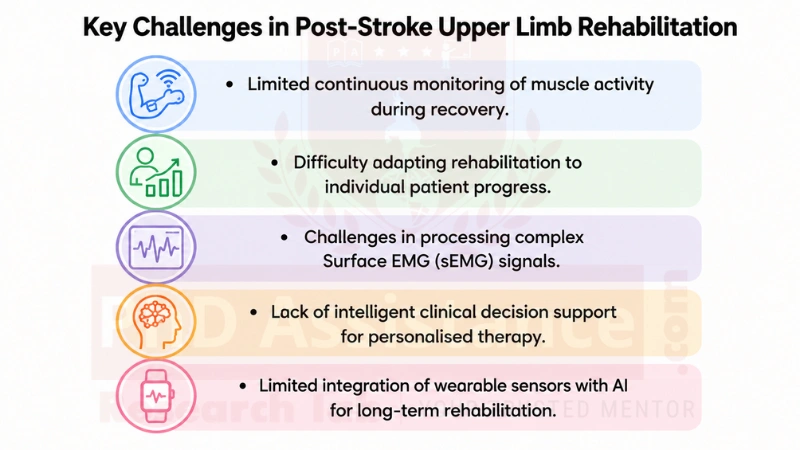
The rapid growth of wearable sensing technology, artificial intelligence, and biomedical engineering has caused a revolution in the assessment and therapy of neurological disorders, particularly post-stroke recovery. Intelligent Wearable Healthcare Systems have become an area of intensive research, allowing medical practitioners to measure and analyse objective muscle activities, motor abilities, and the patient’s recovery status via physiological signal processing. Such technological advancements enable evidence-based medicine, personalisation of treatment plans, and improve the outcomes of rehabilitation therapy using timely and correct health information. Among these applications, Post-Stroke Upper Limb Rehabilitation Monitoring stands out as one of the most important and urgent tasks to facilitate functional recovery and implement a patient-centred approach to rehabilitation. Nevertheless, there remain many unresolved problems in terms of long-term monitoring reliability, processing of complicated physiological data, adaptation to patient recovery dynamics, and clinical decision-making support. Solving such problems is crucial to create intelligent and adaptive rehabilitation solutions.
Proposed PhD Title 1: Intelligent Wearable Framework for Quantitative Neuromuscular Assessment and Clinical Decision Support in Stroke Recovery
Stroke is still one of the primary causes of upper limb disability with permanent muscle weakness, problems with motor control, and a low level of functional independence. New developments in the field of Surface Electromyography (sEMG) allow more precise evaluation of muscle activation and therefore understanding of the degree of neuromuscular impairment during rehabilitation. The paper by Lv et al. revealed that multi-channel EMG measurement allows characterisation of weakness patterns in muscles affected after stroke but was restricted only to clinical measurements rather than long-term monitoring in rehabilitation programs. Biomedical Sensors can be used for physiological data collection in a long-term manner within the context of a rehabilitation program. Moreover, a combination of Surface EMG-Based Sensors with intelligent algorithms allows personalised treatment through constant monitoring of the motor recovery process.
Problem Statement:
The current rehabilitation procedures mostly evaluate muscle functionality during clinical sessions through Surface Electromyography. Existing Wearable Sensors can hardly provide continuous data collection, objective assessment of recovery, and clinical feedback. As a result, the rehabilitation programs usually fail to adjust depending on the physiological condition, thus leading to inefficiency and low efficacy of treatments.
Research Gap:
Although sEMG is capable of quantifying muscle function deficit after a stroke, the current literature does not have much focus on integrating these physiological parameters with decision support systems that could enable individualized treatment.
intelligence to develop adaptive finance prediction frameworks.
Research Question:
How can intelligent Wearable EMG Sensors improve personalised rehabilitation by enabling continuous Neuromuscular diagnosis of upper limb recovery among post-stroke patients?
Outcome:
This study will develop an intelligent rehabilitation platform by using Biomedical Sensors to continuously assess patients and make personalised suggestions for therapy. It is anticipated that the platform will increase the effectiveness of rehabilitation, assist in making decisions based on evidence, and ensure proper functional recovery from strokes.
Reference:
Lv, W., Liu, K., Zhou, P., Huang, F., & Lu, Z. (2023). Surface EMG analysis of weakness distribution in upper limb muscles post-stroke. Frontiers in Neurology, 14, 1135564..
Proposed PhD Title 2. Adaptive Machine Learning for Personalised Motor Function Prediction Using Surface Electromyography in Stroke Survivors
The accurate evaluation of the degree of recovery of motor functions of the upper limb is an important prerequisite for developing a rehabilitation program for stroke patients. Due to recent technological advancements in the field of wearable devices, it became possible to constantly collect physiological data that is objective enough to reflect motor skills. The article published in Sensors (2025) shows how the processing of electromyographic signals and machine learning techniques can be used to improve the analysis of data collected to assess patients’ rehabilitation. However, the algorithm suggested in the paper was only tested under the conditions of experiments, which restricts its application in clinical practice. The combination of Wearable Sensors and Biomedical Wearable Sensors allows for the development of an intelligent system for the analysis of patients’ motor recovery.
Problem Statement:
While there is proof that Wearable Sensors are promising in detecting muscle activity for rehabilitation purposes, current machine learning algorithms lack adaptability in different stroke patients and recovery levels. Furthermore, current models using Surface Electromyography often require experimental data sets in controlled settings, preventing them from providing accurate predictions for patients in the context of rehabilitation.
Research Gap:
The existing machine learning techniques are mostly based on stationary or experimental data sets, which makes it difficult for these approaches to adjust to the individual recovery progressions and make predictions.
Research question:
How can adaptive machine learning models using Surface Electromyography improve continuous Neuromuscular Monitoring for personalised assessment of post-stroke upper limb rehabilitation?
Outcome:
The research will establish an Intelligent Rehabilitation Assessment Framework incorporating Wearable Sensors combined with adaptive learning to improve predictions about the recovery process, facilitate personalised rehabilitation planning, assist clinical decision-making, and allow for long-term upper limb motor function monitoring.
Reference:
Sensors. (2025). Wearable EMG sensor framework for upper limb rehabilitation assessment after stroke. Sensors, 25, 1057.
Proposed PhD Title 3. High-Density Muscle Synergy Modelling for Digital Biomarker Discovery in Post-Stroke Motor Dysfunction
Evaluations of muscle coordination are necessary in rehabilitation of the upper limb after stroke for gaining knowledge of motor recovery and for optimising interventions. Evaluation methods based on electromyography often give insufficient information about muscle interaction in functional movement. The study conducted by Wu et al. demonstrated the importance of high-density electromyography for analysing the patterns of muscle activation and detecting muscle synergies related to post-stroke recovery. But the methodology suggested by the authors was mainly used in laboratories without the presence of a wearable device for continuous rehabilitation evaluation. The combination of Surface EMG-Based Sensors with Biomedical Sensors can be very effective in collecting muscle activity data under natural conditions. This can give clinicians complete physiological information for evaluating the progress of rehabilitation and developing personalised treatments for patients with stroke.
Problem Statement:
The currently available high-resolution EMG systems offer sophisticated analysis of muscle coordination but are difficult to use in rehabilitation practice due to their complicated technical apparatus. Moreover, existing sEMG techniques and wearable sensors lack the capacity to transform muscle synergy data into practical monitoring devices that could be used in real-life rehabilitation settings.
Research Gap:
Currently conducted muscle synergy studies mostly define activation patterns of muscles with the absence of valid digital biomarkers that could quantify the degree of movement disorders and recovery of functions. Moreover, there is not enough work done to transform the physiological markers into clinical parameters for personalised therapy and prognosis of treatment success.
Research Question:
How can high-density Surface Electromyography and Wearable Sensors improve Neuromuscular diagnosis through digital biomarker discovery for post-stroke motor recovery?
Outcome:
This proposed study will design a wearable high-density monitoring system based on the use of Biomedical Sensors to measure continuous muscle coordination. This new method is anticipated to increase the accuracy of rehabilitation assessment, offer personalised treatment, and help make clinical decisions based on evidence.
Reference:
Wu, et al. High-density electromyography for upper limb muscle synergy assessment during post-stroke rehabilitation. NIHMS-1748491.
Proposed PhD Title 4. An Artificial Intelligence-Driven Remote Monitoring Platform for Continuous Functional Recovery Assessment After Stroke
The use of home-based rehabilitation has emerged as a critical approach in the process of increasing functional recovery among stroke patients because it allows for continuous rehabilitation outside the hospital environment. The recent advancements in wearable sensor technology have made remote tracking of motor performance possible, thus limiting the need for frequent clinical consultations. The paper published in Sensors (2024) highlighted the ability of intelligent rehabilitation devices to capture the physiological data of patients when engaging in upper limb rehabilitation exercises. But the proposed framework was mainly concerned with the aspect of rehabilitation aid and did not incorporate any artificial intelligence model for continuous analysis of the recovery of patients at home. The combination of Surface EMG-Based Wearable Sensors and Biomedical Sensors can provide the opportunity to achieve the above objectives.
Problem Statement:
Although there have been advancements in the field of digital rehabilitation, the current generation of home-based digital rehabilitation solutions offer very little potential for interpretation of continuous muscle activity obtained using Surface Electromyography. Currently available Wearable Sensors concentrate more on obtaining physiological information rather than providing any intelligent analysis, which limits their potential to provide personalised rehabilitation assistance.
Research Gap:
The remote rehabilitation tools currently available focus mainly on the delivery of exercises as well as their measurement but have very little capacity to analyse the physiological measurements. This means that clinicians do not get any objective, real-time data about their patients’ progress, making personal interventions and remote clinical decisions impossible.
Research Question:
How can artificial intelligence enhance Wearable Sensors and Surface Electromyography for continuous Neuromuscular diagnosis in home-based stroke recovery?
Outcome:
The suggested research would entail the development of an intelligent home-based rehabilitation framework with the aid of Biomedical Sensors, which will be used to deliver adaptive rehabilitation assessment, personalised rehabilitation advice, and remote clinical surveillance.
Reference:
Sensors. (2024). Artificial intelligence-assisted wearable rehabilitation system for post-stroke upper limb recovery. Sensors, 24, 554.
Proposed PhD Title 5. A Digital Twin-Enabled Precision Rehabilitation Framework for Predicting Functional Recovery in Stroke Survivors
Although substantial advancements have been made in terms of technologies used for the rehabilitation process following a stroke incident, there are still some difficulties associated with determining the future recovery pattern for each patient and designing an appropriate strategy to support them in the rehabilitation process. According to a recent study published in Frontiers in Neurology (2024), the problem lies in the necessity of developing an intelligent system that will allow incorporating the physiological information into the rehabilitation model of a particular patient. The rehabilitation platforms currently available mostly assess the motor abilities of a person at a given moment but do not predict future outcomes. The incorporation of Surface EMG-Based Sensors with Biomedical Sensors within the digital twin ecosystem can be used to predict the recovery process of a particular patient.
Problem Statement:
The technologies currently being used in rehabilitation that rely on Surface Electromyography only analyse the current level of motor function and do not provide any predictions about future recovery. Moreover, the Wearable Sensors available today have never been combined with predictive computational models that could simulate the rehabilitation process specific to each patient.
Research Gap:
The current models for rehabilitation offer minimal ability to model individual recovery pathways, thereby limiting predictive treatment planning and optimising therapy. In addition, existing models do not leverage the potential of digital twin technology and physiological information in developing virtual models of patients that can facilitate precision rehabilitation and proactive decision-making.
Research Question:
How can digital twin technology establish patient-specific virtual models for predicting functional recovery using Wearable Sensors and Surface Electromyography?
Outcome:
The research to be conducted will seek to design an efficient and effective rehabilitation model by means of a Digital Twin with Biomedical Sensors, which will assist in predicting recovery paths, personalising rehabilitation programmes, and enabling timely clinical decision-making.
Reference:
Frontiers in Neurology. (2024). Emerging wearable technologies and future perspectives for post-stroke upper limb rehabilitation. Frontiers in Neurology, 15, 1470759.
Need assistance finalising your dissertation topic in Surface EMG-Based Wearable Sensors? Selecting a strong, researchable topic can be challenging — but you don’t have to do it alone.
Our research consultants can help refine your ideas, identify literature gaps, and guide you toward a topic that aligns with current academic trends and your programme requirements.
Contact us to begin one-on-one topic development and refinement with PhdAssistance.com Research Lab.
Share this:
Cite this work
PhDAssistance. (n.d.). Virtual Influencers Dissertation Titles Retrieved 30th January 2026, from https://phdassistance.com/title/virtual-influencers/
“Virtual Influencers Dissertation Titles, https://phdassistance.com/title/virtual-influencers/
“Virtual Influencers Dissertation Titles” PhDAssistance, PhDAssistance, Tuesday, January 30th,2026.
PhDAssistance, n.d. Virtual Influencers Dissertation Titles[Online]. Available at: https://phdassistance.com/title/virtual-influencers/ [Accessed January 30th, 2026].
PhDAssistance. Virtual Influencers Dissertation Titles[Internet]. PhDAssistance; [cited 2026 January 30th]. Available from: https://phdassistance.com/title/virtual-influencers/
PhDAssistance (n.d.).
Virtual Influencers Dissertation Titles. Retrieved January 30th, 2026, from https://phdassistance.com/title/virtual-influencers/
PhDAssistance, Virtual Influencers Dissertation Titles(PhDAssistance, n.d. January 30th accessed 2026.
Study Resources
Free resources to assist you with your university studies!